Other Pages

Monday, July 8, 2013

Wales II

27th June, 2013                                                                      
..................... ........... ........  .....   ...    .   .      .       .                  .                                            .
                                           Snowdonia  
                                           Suoʍpouıɐ

Part of the stay in Snowdonia involved two days with the tour leader in North Wales known as Gareth Jones. Advertisements for his tours were strung all over birding sites and hides. A prompt 4 am departure does not sound pleasant but its the norm if you hope to be into birds. Though it is true that all you can see at 4 am are many shades of black and darkness, this early rise was needed to locate one of the target birds which was the black grouse. The species is quite local and sparsely distributed, and they, like most bird species, are far easier to locate earlier in the morning. In the grouse's case it was because they lek only during sunrise, and after 7am they tend to disperse into the dense bracken where they become extremely elusive.

A notably narrow labyrinth of farmland roads were traversed for what felt like an eternity before reaching a location with a Welsh name (sorry, I didn't write these names down). A "No Parking" sign hanging off a pine tree where the car promptly "stopped" and we both "accidentally" got out and walked off down the trail. The shade of the pine forest quite rapidly opened out into a moorland-heatherland type habitat. It was a hilly location where bracken abounded and trees grew only fleetingly. It took another 10 or so minute walk before the first black grouse flew over the valley, presumably a male that had already finished its calling/lekking on the "lek site" from the hillside to the left. It landed, thankfully, though in a dense clump of bracken. It was most certainly identifiable by its black figure, white markings and red eyebrow, though views could always be better. Another 10 or so minute walk and the scope was set up aimed at the lek site where a few more grouse were seen occasionally. They would hide in the bracken and sometimes jump up every now and then, rarely staying exposed for so long. It was most certainly like a rusty whack-a-mole game.

There are 2 black grouse in this poor but acceptable
 image. The most visible one was the only grouse that
gave confiding views.
With black grouse over and done with (well not really, since I'd rather have closer views!) this site was done with. Well nearly. Before moving on it was suggested that both whinchat and grasshopper warbler (or g'ropper to you lazier birders) were regular in the area, and both had been recording here recently. The whinchat's name is one I have not been able to find sources on, and one of the species that hides in the back of the field guide. Only serious birders would probably have heard of it, for it isn't one that tends to perch on the garden wall. I did not know what to expect of the whinchat. I had seen its commoner cousin the stonechat widely, and I wasn't certain whether whinny (insert cringe by other birders who just read that word, but yes, carry on with your "normal" abbreviations like gropper, mipit and piefly. PS I made up whinny just for the purpose of this conversation) was a fairly confiding bird of open areas just like its cousin.

The chorus of mistle thrush and other assorted common birds was broken by a distinct call for a long time, though it apparently took a few minutes before either of us really picked up on it. I certainly would have mentioned it earlier if I noticed it, but it was probably the most basic and simple call I had ever heard. If I had heard something as complex as a veery or wood thrush I no doubt would have asked "what bird is that" but for something that sounded so basic I never even considered asking! The sound came from a male whinchat perched on an exposed branch of a tree along with a "mipit". Though it was not as attractive as its cousin, it was still quite unique. There is no other bird that really resembles the male in shiny breeding colouration.
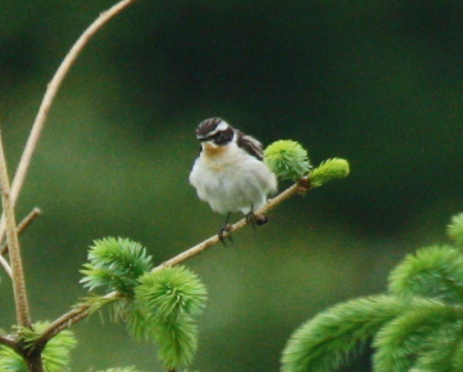
But talk of femalechats, moultingchat and juvchats during
autumn and winter and people groan at the idea
of trying to seperate them.

The next stop was a woodland place with a Welsh name some distance from the first location. This mixed woodland was supposed to hold many target birds, and I certainly didn't doubt that. A jay was present on one of the picnic tables, and though I'm sure I have seen them before this is the first real look I've had at one of these pink crows (and more importantly the first time I've seen one while I've had a camera). I won't post a picture because everyone knows what a jay looks like and this blog is highly limited in what I can upload. If a reader doesn't know what the european jay looks like (not the funny blue ones in America) then my vague (but relevant) description will have to suffice.


                                                                                 Imagine a crow. But louder. And pink. 
                                                           (Image from www.changeipadwallpaper.com)
                                PS: Increasing your volume for a more dramatic effect while visiting that link
                                                                     is recommended.


The picnic bench used for lunch was unfortunately occupied, but the occupants which consisted of hundreds of irritating biting midges were more than happy to let us sit there. A convenient insect repellent spray was simply raised in the air and sprayed directly on the swarm which caused it to dissipate rapidly. Though, it only took 5 minutes before they wanted their seat back.

A bullfinch called its distinct piping whistle from the distant trees, but Gareth did not agree on grounds it sounded too sharp, though he could not offer an alternative ID.  However he was perfectly happy with calling a supposed pied flycatcher, which, from the fleeting views I personally saw, looked no more different from a female chaffinch, something that was abundant in the vicinity. I feel that a male pied flycatcher as he described it would have looked entirely different, though perhaps I was looking in the wrong place. It did not return, and multiple attempts made for this species elsewhere on my time in Wales did not locate this bird. A distant crossbill was heard over the forest, as were lesser redpolls and siskins. Wood-warbler was not located. Redstart was heard singing, but (as usual) not seen. Little else was seen here, though the scenery was nice. An unknown bird perched fleetingly on a pine tree, and it was a tricky ID with poor lighting and angle. All the people I have sent the image to have concluded at a 70-90% chance that it must be spotted flycatcher.

Gareth suggested a scan over the moorlands outside the forest with the Welsh name, as such a location was noted to be a regular haunt for hen harriers (the male of which is his favourite bird), short-eared owls, merlin and golden plover. Of course the rain and drizzle was off-putting, and none of these special birds were seen. Some of the small lakes were quite interesting, having singles of both black-backed gulls despite the distance from the sea. A small non-descript bird scattered across the road at one point, and looked quite wader like. It was a juvenile common sandpiper, and a slightly agitated adult bird flew up to a post nearby. This adult bird, presumably a little concerned about its young running around the roads, cheeped its defiance at us from its post and was quite tenacious. It did not budge even when down to less than a metre.. Of course the car had to be reversed, since such a close bird was far too close for my telephoto lens. It sat there infinitely, sticking to its perch even when the car drove onwards about 12 minutes later. Its presence by the road made it impossible to give it a wide radius (something a good birder should always do regarding nesting birds) but we tried not to bother it any more than required. It was there on the return as well.


A distant northern wheatear was looking quite good, even in the overcast weather.


Views of willow warbler and a single tree pipit (the latter after considerable effort) were obtained further down the path. The next series of stops (and the last I will include in this post) involved the search for a rather plump river bird known as the dipper. This bird irritated Gareth on this one day, as he was frustrated with the absence of any sightings along regular rivers for the bird. To find it we actually had to visit a nesting site itself, where it frequently turned up. It was always on the far side of the river, yielding only far away views, but I won't complain.

A dipper...uh...dipping. Yeah, let's go with that.


Tuesday, July 2, 2013

Wales I

25th June, 2013                                                                      
..................... ........... ........  .....   ...    .   .      .       .                  .                                            .
                                           Ironbridge

Before Wales steals the show there is more from England. To shorten the long drive an overnight stop was made at Ironbridge, a small village nestled along the River Severn. Since it was only overnight stay there was little time to travel around here, though nontheless there was a lot to see. I was fortunate to find a cardinal beetle in the undergrowth along the river side, in a shaded area which was quite diverse in life. Greater celandine, a plant I've always seen in books but never previously seen, was very common along some areas here. In the forest across the river there was a black-headed cardinal beetle, the cardinal beetle's rarer and black-headed cousin. I previously lacked any photos of either species (though had seen both in my past, at a time when I had no camera access), so it was quite fortuitous to be able to photograph both of these rather uncommon beetles within an hour of each other. A blood-vein moth was a common species over most of the UK, but another first for me since mothing was not something I had ever had a chance to be involved in. I will not post photos of them for the sake of my blog's image capacity.

In the afternoon there was a kingfisher over the river, another previously seen species in my past but not one I had ever seen when I've had a camera on hand. It was unfortunately distant and the lighting was poor but it doesn't change the fact that this is a photo of a kingfisher.
It did sit, but not long enough for decent pictures.

A small garden named Dales End Park was watched over by a pair of spotted flycatchers. I had not seen the species in the UK before, but have seen a couple in France back in 2009.

26th June, 2013                                                                      
..................... ........... ........  .....   ...    .   .      .       .                  .                                            .
                                           Snowdonia  

Snowdonia is a frequent destination in North Wales, and it certainly is hard to miss. This National Park compromises about a third of the northern region of Wales and is attractive to tourists, climbers and wildlife watchers. The Snowdon lily, a white flower in the high hills, takes the name of this location, though to ruin this  image of a rare mountain flower (its rare in the UK at least) it is actually found all over the world in many locations. Then again, it is thought to be a bit more significant in the UK since it is not only local and low in distribution. I don't imagine global warming will help this species at all, something that will probably happen with the small mountain ringlet as well.

Since the first day was a exploration of the local town and rest from the drive there was little to report. The "hawk of fish" as it is translated from the welsh gwalch y psygod breeds in the Snowdon mountains, and one such RSPB site named Glaslyn (named after the lake that the birds feed from) offered opportunities to see the birds. Though it did indeed offer sightings, the white speck visible through the very expensive looking giant super-telescopes provided at the hide were unquestionably disappointing. No doubt the worst bird photo ever taken, but still, I guess it is still a "tick". I don't imagine the crystal clear close up photos of these birds all over the hide and visitor centre were taken through those telescopes or from this distance.

That white and brown blob on that exposed tree branch is it.
Its there, I promise. The second white spot on the branch to the right might be
another but its impossible to tell from here. That dark U-shape in the
branches to the right of the centre is where the nest is hiding.

Saturday, June 22, 2013

England I

On holiday to England for a while so no doubt there'll be a few new things to post on here (hopefully more than a few). Since the hosting gallery for this blog is going "waaa you have no file space left" I will be limiting the pictures I post.

Locally in southern Hampshire I was impressed to find a stag beetle threatened with being stepped on by frequent pedestrians. I did not have my camera with me, and this is the first time I've seen one alive so I was quick to carry it home (which admittedly was only a short walk down the street). Stunning beetle.


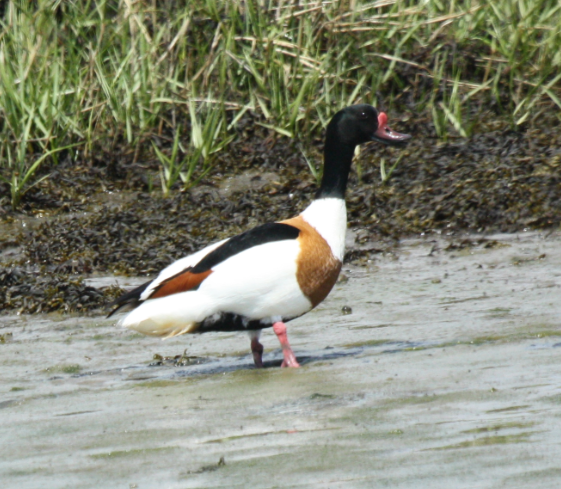
I was finally able to get good looks at shelduck. This common bird is one I apparently never recorded while in the UK before, one of many common birds I apparently just forgot to write down and photograph. Well here it is anyway:


Peregrine falcon at Calshot was a well-awaited tick and a bird I should have had ages ago.

21st June, 2013                                                                      

Hurst Castle has been a bit of a local favourite of mine. There are some good habitats around this coastal part of the New Forest with good shots at many sea birds, plants and insects. This place was once home to a colony of Glanville fritillaries as well, an early April-June species that would have died off several weeks ago if not earlier. It is not really known how these butterflies colonized here, but it is assumed that they have been blown over from the Isle of Wight, the nearest (and only) breeding area for the species in England.

The rain and strong winds didn't help with birds or insects and it was a bit of a dreary trudge along the shingle bank, a combination that probably would have sent a lot of people home. Eventually the rain did stop and the sun showed itself beautifully. The first sign of sun were cinnabar moths which popped up all over the place in the meadows along Hurst Castle. Small heath butterflies soon followed, a butterfly that never opens its wings except when flying.

A rather late small blue butterfly was an interesting initial encounter. These are also April-May flyers, at the latest trickling into early June. Unlike other blues it is most often brown in appearance. They are pale blue underneath though, similar to holly blues. Their host plant is kidney vetch, a scattered plant locally common on the Hurst Castle area. It can also be seen in the picture below:


While chasing small heaths for upperside shots I immediately came upon a "large heath" gliding around the meadows. When it finally touched down on the path it flicking its wings momentarily before settling. This behaviour is common in several carpet moths in Geometridae, but I have never seen it in a butterfly before. As I saw it head on there wasn't much to gather from this paper-thin view except dark antennae with obvious orange tips. So what was this odd butterfly? A bit of repositioning and there wasn't any doubt to what it was -- it was the fabled Glanville fritillary!


Fantastic. It was not particularly wary and I was able to walk it onto my hand for a split second before it took off. That's one tick off the wishlist!

But what was this early species doing many weeks after the latest known records for this species? It probably has to do with the poor spring the UK had this year. The incessant rain and cool temperatures seemed to have fluctuated a few species' flight times, proved by sightings such as that small blue earlier which was unusual but not as unheard of as a late Glanville. A fantastic sighting, and apparently this was actually the only known 2013 sighting of the species at Hurst Castle at all. Until I handed my sighting in, the Hurst Castle colony was thought to have been completely extirpated out from the cold winter of 2012 and torrential spring of 2013.


I paid a short visit to the marshes towards Keyhaven and Pennington as well. A few lagoons in and I was informed by a birder that the two distant white blobs were in fact a pair of spoonbills, a rather rare but increasingly abundant species in the UK. Of course, with the strong winds they were completely huddled up and the identifying feature was invisible, though the posture was notably different to that of a huddled little egret. When the black-tailed godwits took off there a short window opened up to see their unusual bills, but it was soon concealed after.

Another long-awaited new bird for me was stock dove, a pair of which were quite partial to the stone pathway along the marshes. A good end to a special kind of day that will become harder to find as I "tick" more and more species.

So? It's just a pigeon. Nothing special about that is there. See those everyday.
In the cities, in the garden. Its not like there is more than one type of pigeon out
there.


Sunday, April 28, 2013

April 27th Ventura pelagic

27th April, 2013                                                    

A pelagic trip was scheduled today and it was no small ferry outing at longer than 12 hours. It required me to get up at 5:30am to leave harbour at 7am. We returned at 8:11pm. It was nothing compared to the pitiful 7-9 hours of previous trips I had joined.

Sunrise over Ventura harbour.
The two colours of a perfect sunrise, orange and black, lit up the harbour. A caspian tern pair were borderline interesting, and a species I don't see super often.

Caspian tern (from an earlier trip).
A little out a single Clark's Grebe accompanied a single Western Grebe. The rather limited beach held willet, grey plover, black oystercatcher and an American crow partaking in a bit of beach scavenging. Bottlenose dolphin made a brief presence in the small bay area.

Common murre soon became regular as the coastline was left in our wake. I had no doubt seen this species under the name guillemot in England several years ago, though I've never recorded it before. The lighting was not too great though. Scripp's murrelet and Cassin's auklet indulged us with erratic distant appearances. Cassin's in particular are challenging to find in the open sea, as a dark speck literally "the size of a tennis ball".
Bad lighting, bad...

PENGUINS. No, not really. Scripp's Murrelet.
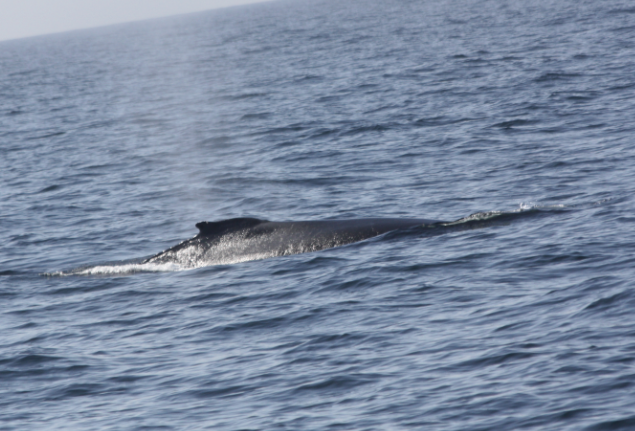
The freshwater Black Tern seemed an oddity this far out to sea, but we encountered 4 in total on floating kelp patches. Rhinoceros Auklet started appearing too, though they weren't a big deal for me since I'd seen them much closer before.  Humpback whales appeared in enough numbers to please a whale-watching trip.

No points for guessing why its called a Humpback Whale.
The ashy storm-petrels appeared soon enough, though scattered again. A fork-tailed storm-petrel was called out by two people who saw it "fly right past the boat", and I was not one of them. It was not helpful that I was standing next to the person who saw it, while looking in the same direction! Bonaparte's gulls populated the empty space often held by western and Heerman's gull closer to shore, and the odd Sabine's Gull started appearing here and there. These gulls use the same colors scheme as all the other gulls but manage to look much more flashy.


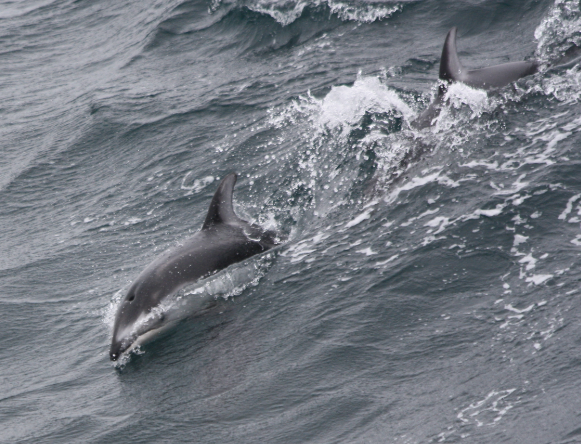
Few on board were particularly interested in the white-sided dolphins that passed by. Usually the announcer calls out mammals even if there is minimal interest, but not for these ones. I'm lucky I was standing on the right side of the boat for them. They weren't too easy to find in the rough waters here, but the undulating seas made them more conspicuous than usual when they did breach.
Pacific White-sided Dolphin
The target birds were albatrosses, the charismatic gliders that people often associate with the open ocean. The name translates to white wanderer, and how funny is it that my first albatross is infact not white at all. The black-footed albatross came in a pair and made an effort to approach the boat for the bait that was being thrown out to attract them. It is thought that the smell of these birds is quite good--when you are looking for food out in the desolate ocean there certainly is little chance of using even the best eyesight to spot the nearest food several miles away.

Chocolatetross.

Even though it has black feet, you'd think it would be named after something more obvious. Like, perhaps, the entire
colouration of the bird which clearly differs from the usual white species.
Each albatross has its own unique facial expression when viewed head on. Most of them look angry though.

The second albatross species was the Laysan albatross, and a more typical looking member of the group. It is rarer in California waters.


The rest of the trip was remarkably quiet... But I must say nothing was quite as complete without the cupcake-shaped sunset.


Sunday, February 24, 2013

Some ducks with funny names

I've had two new ducks recently, both winter visitors, and both at Oak Canyon Community Park.

First off was this female Canvasback.


A few weeks ago I had a pair of (aptly named) Redhead. Had a nice size comparison with the local ducks going on too! Just need a Coot in there. It's a little blurry since there was barely any sun left at the time (5pm).


This winter passage Red-naped Sapsucker appeared at Chumash Park on the 4th.


And I may or may not have an Allen's hummingbird sitting in a nest outside the house right now.