Other Pages

Showing posts with label north america. Show all posts

Sunday, February 7, 2016

Shifting Focus

One of the events taking place right now in Los Angeles is something called a "snailblitz", a concentrated effort to record snails and slugs. The fun thing about it is that who actually spends time looking at snails!? I certainly didn't, until recently. I mean sure I photographed snails, but I didn't actually put time aside to specifically look for them. For me, the majority of my experiences with snails were walks in the middle of the night or during a rainy morning, when I heard a sudden "crunch" under my feet.

You can't just happen upon a rare native snail, or, let's face it, even a common native snail. During the day, most snails hide out, in cracks of trees, or under bark. Many species are only 1-2mm in size too, and when a pinpoint-sized micro snail is only found in a shady crack of select trees in a great forest, it becomes troubling indeed. The biggest issue is that fallen logs are not easy to come by here for some reason. But I mean, snails eat your prized geraniums and cabbages too, so that's another reason why this event is a new frontier for many people. Certainly I had only puzzled looks when trying to convince multiple people, all independently mind you, that no, I did not in fact lose something in the leaf litter, but I was actually documenting snails.

One early hike that went out, one that I was invited to but could not attend, found a great colony of Southern California shoulderband, a stunning native species that is considered to be endangered.. Naturally, in such an urban superzone that is Los Angeles, most of our expected snails are introduced from Europe or Asia. To find a native snail, one had to be quite lucky and also search in the perfect spots. There are about 15-20 native snails in Los Angeles county, and guess how many I have seen. A grand total of 0.

Though I could not attend the event itself, I was able to turn up yesterday and look around. I found the fallen log, the only log of its kind in the area, and rolled it back. There was a discouraging 10 seconds of scouring the litter-ridden forest floor, but finally, hiding under a sycamore leaf, was that shoulder-striped shell I had been looking for. I found a few of them after a bit more searching, before returning the log to its original position and covering the sides with leaf litter to try and revive the sealed-off microhabitat that was originally there.

Southern California shoulderband, Helminthoglypta tudiculata!
What I could not find was the invasive rounded snail, Discus rotundatus. Why would anyone care about seeing an introduced snail? Well, it's another species to see, isn't it? More importantly, its one I haven't seen yet! With the target species achieved, I spent some time checking out other areas of Eaton Canyon. I knocked off some sycamore bark nearby which revealed an unusual miniature Zopherid beetle Bitoma sulcata. In the same park area I was also treated to a harvestman Protolophus singularis, sand pygmyweed Crassula connata, the somewhat uncommon jointed charlock Raphanus raphanistrum.

Bitoma sulcata
Sand Pygmyweed, Crassula connata. Blink and you'll miss it! Then again, it's easy to miss it even if it wasn't
1mm in size.

Jointed charlock, Raphanus raphanistrum

Also somewhat notable was the invasion of annual stinging nettle, Urtica urens. This one was in full bloom, which is not common, at least not for me:

Annual nettle, Urtica urens, in full bloom. Maybe not the most exciting flowers
in the world, but a show nonetheless.
A widespread plant here was common phacelia, Phacelia distans. Common they may be, but they are nice to look at. I was not entirely sure if these plants were part of the ornamental garden, or if they were actual wild plants, but several of them had occupied "weedy" spaces, so at least some of them seem good.

Common phacelia, Phacelia distans.

I found a second log halfway through the trail, shaded under a coast live oak. I did not see any more shoulderbands, but I did find Paralaoma servilis. These tiny little shells were easy to miss, but once you find 1, you suddenly see 10, and then 20...They were not the rounded snails I was interested in, but arguably they are an even better find though still not a native species. They are apparently common in Los Angeles, but they are not covered in any literature and few experts know about them.

Paralaoma servilis.
Satisfied, I headed off to explore a different trail. On the way down I found 2 small liverworts growing besides each other, both new species for moi, hairy crystalwort Riccia trichocarpa, and Campbell crystalwort Riccia campbelliana!

Hairy crystalwort, Riccia trichocarpa.
Campbell crystalwort, Riccia campbelliana.
For what was no more than an hour in Eaton Canyon, I was very impressed! On the walk back to the car park I found what may have been my first "tickable" population of sweet alyssum, Lobularia maritima. I've seen the species before, but I've never been crazily confident that those plants I've seen have not just been planted by human hand. It's a common garden plant, but they occasionally spread as a weed, and this group, alongside invasive carnation spurge and petty spurge Euphorbia terracina and peplus, london rocket Sisymbrium irio and western tansy mustard seemed "at home" outside of a garden.

Sweet alyssum, Lobularia maritima.
As usual, you can view my entire trip list on iNaturalist. Today's trip is found here: http://www.inaturalist.org/observations/silversea_starsong?on=2016-2-6

Monday, February 9, 2015

Un-cockaded

Of all of the woodpecker species in North America, the most endangered is the red-cockaded woodpecker. Back in the days when this species was first named, people could probably understand the name of this bird without consulting a dictionary or the internet. The so-called "cockade" on this bird is the small red spot behind each cheek of male birds. These days no living soul seems to know what you are talking about when you use the word cockade, and the term seems to live only in scratchy old text in scratchy old tomes and in the name of this bird. The species epithet is curious as well, borealis, which would suggest it was a northern bird rather than a southern one.

I did not initially realize how lucky I was to be based right next to one of the few strongholds of the species in the world at the Croom section of Withlacoochee State Forest. Though pine forests are not uncommon, this woodpecker is extremely picky on the specifics, and the habitat has to be fairly large to begin with to sustain the species for any decent time. If there are too many of the wrong tree, the trees are not old enough or spaced far enough apart (but not spaced too far apart), if the shrubs are too high, it is no longer suitable for the species. Because the specific habitat it requires takes many decades to form in the first place, the clearing of this habitat is very costly for the future of the species, hence its current scarcity.

As a rare species, it is quite difficult to find information on where to find them to avoid disturbance by overzealous hobbyists (whether it be egg collectors or unethical birdwatchers, which unfortunately are far more common than this woodpecker). I found a sort of a lead when I discovered a field trip report that was several years old. However, it was not much: it merely detailed a trail number.

So that was how I ended up on this remote road, next to a white marker that had different numbers painted on each side, one of which that said "7". There were many of these markers, sometimes just randomly beside the road, and I still don't know to this day whether they were actually trail markers or something else. The big official trail map I obtained for the forest had no numbers marked anywhere. At least the habitat looked correct.

Looks inviting. right?

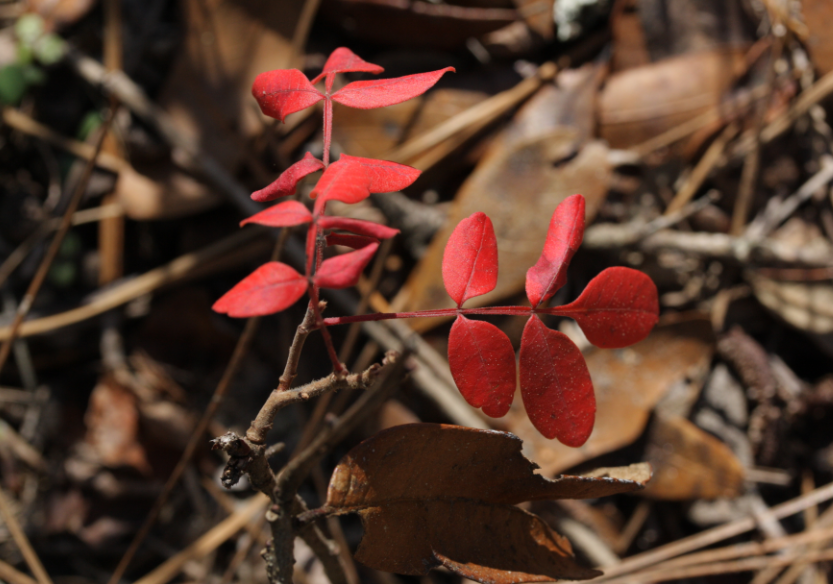
Not very far down the path I had already heard both red-bellied and pileated woodpeckers in the trees above, but little else. Save the occasional calls of these two birds, and the distant song of pine warblers, it could have been described as "pitch silent". By chance I happened upon this interesting autumnal looking specimen of Rhus copallinum:


A while after walking through silence, I noted a pale tree far away, gathered between its darker brethren. This tree was my first clue to this woodpecker's presence, and a useful landmark. As part of a conservation effort to keep snakes out of nests, conservationists shave the bark off known woodpecker nesting trees from the ground up to about two thirds up.


And if there was any doubt that this was a nesting tree...

Look, a hole!
There was one thing missing from this secret wooded glade, see if you can guess what that was. Either way it was a nice diversion, even if it was only for this moth which I happened upon by chance:

The geometrid moth Pseudanthracia coracias.
And another moth down the path:

Uresiphita reversalis. A more stunning moth if you see the wings spread out, unfortunately too skittish this time around
to capture.
Eventually, after a few miles of walking, I finally heard a rather raucous sound up in the pine canopy. It sounded more like a squeaky toy than a bird, and more like a parrot or parakeet. I noticed a small black and white woodpecker moving its way up a tree: just a downy woodpecker, but that was certainly not the bird that made that sound. A bit more searching and another woodpecker silhouette peeked its head from around the trunk of a tree, flashed its white cheeks, and there was my red-cockaded woodpecker. I took a few photographs of the speck-sized bird over a long distance, but at least it shows up in the pictures. It flew off after my third or so shot and rattled across the forest. A wonderful sighting despite the distance.

When the sun decided to peek through the clouds a few dogface butterflies drifted about the sunny vegetation, eternally expressing their habit of never landing. Other birds started picking up, including two very bright yellow palm warblers. One bird flew towards the tree beside me and landed a mere three feet or so above my head. Wait -- surely not? I had to take a few steps back but there was no doubt there--America's rarest woodpecker had flown across the pines and set down on the tree right beside. Despite its poor positioning with regards to light, no one could have asked for any better.

This bird was banded with the colour code WRW PBR. As a female, this
is not the most red-cockaded of red-cockaded woodpeckers. In fact it is quite un-cockaded.

Based on the time stamps of my photographs, this bird was on this tree for nearly 10 minutes. In that time it not only showed impeccably, but even hopped down the tree to head-height level, behaviour I had not seen from a woodpecker before. Even after it had left I was standing quite still, captivated by what had once been.

On the return path I encountered a stunning member of an already stunning family of tiger moths, Utetheisa ornatrix. In flight this species reveals its vibrantly red hindwings and orange underwings, though at rest it is more unassuming:


I had to temporarily hold it in a box to get non-flight views of its stunning colouration on the hindwings, as well as underneath.


I also cruised into this neat spider while traversing the brush. This spider is a nice tropical equivalent of the more temperate garden spider, and interesting to look at it:


And then finished off the day with my first snake on this trip so far: a black racer that I kicked up while walking off the path. I managed to relocate it hiding under a bush nearby for some better photographs. Remember kids, the first rule of encountering a snake is to get as close as you can. (Really -- don't do that).


Saturday, January 31, 2015

10,000 Steps

I once heard that Honeymoon Island was some form of wader haven. Admittedly this site is only one of two locations in this region of Florida that can boast a species total of 300 species or more, which suggests off the bat it is a good migrant trap as well.
Hotspot map courtesy of eBird.org and Google (maps). Fort de Soto Park is the lower red marker.

Some recent bird reports from the area had also been promising, including several waders that I either had not seen before because of sheer unluckiness or had never been in the range of to begin with. The most notable was the rather petite piping plover, a bird that is also endangered and rather rare.

The first impression of the location was perhaps not the best. What little there was of a beach for waders was packed full of people, despite it being a weekday. Half of the lower beach was closed off with heavy construction vehicles and metal fences, certainly not immediately promising!

I had walked for over an hour before seeing anything but a scattering of gulls, terns, palm warblers and ospreys. No sign of any shorebirds anywhere along this massive stretch of beach. Fortunately there were less and less people the further north I walked but there were still enough seashell collectors passing through to disturb any bird foraging here. After much walking I finally encountered the first shorebird of the day, a single sanderling on the edge of the water. Though a nice looking wader it is not uncommon for hundreds of these white birds packed tightly together on sun-speckled winter sands back in California.

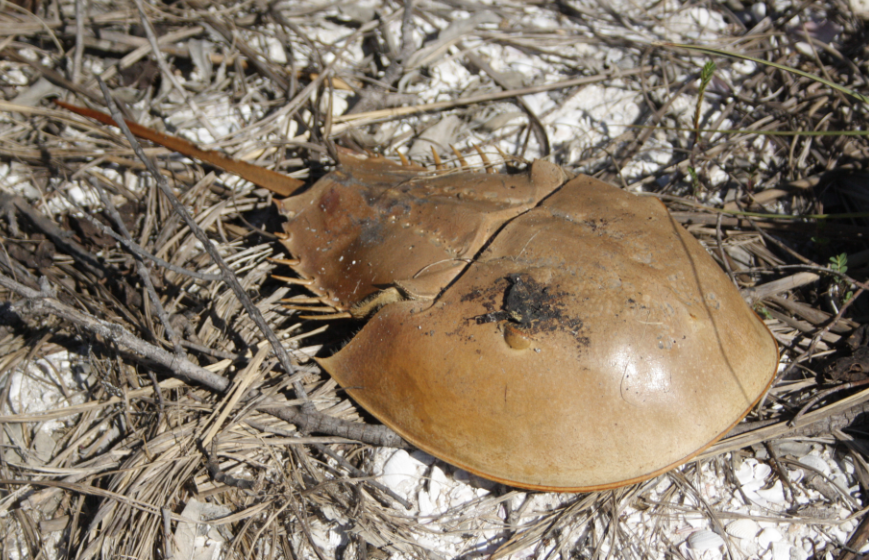
I did see some horseshoe crabs though, albeit dead.


Finally I found something. The next spark of hope, or perhaps shadow of hope, were a pair of well-sized dark birds: American oystercatchers. Finally, a good start to the trip!

They certainly have interesting eyes. Unlike the European species, the eyes are pale yellow and not red.
With the fading presence of people, it was good to start finally seeing birds. Inevitably the first grey shaded willets of the day soon appeared and grew in numbers. A massive congregation of birds were preening at the very end of the spit, and smaller scattered flocks of other waders were found throughout. It seemed that the wader haven I had seen seeking was all squished into this tiny northern tip of the island.

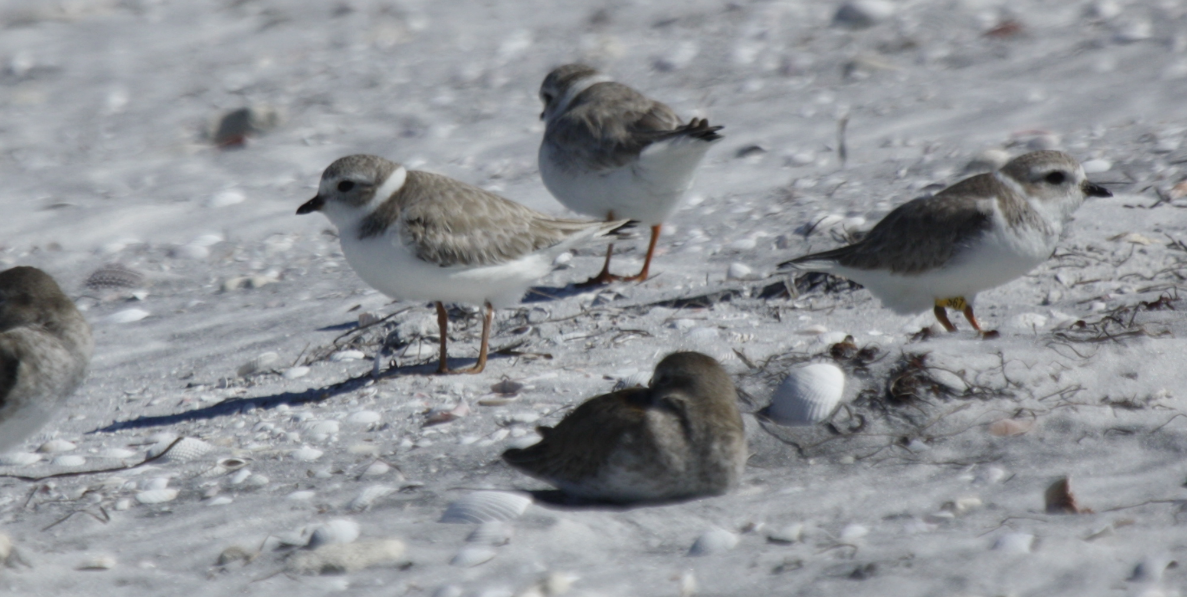
Before I reached the main wader flocks I found some small rather sandy coloured plovers bunched together with sanderling and dunlin. Piping plovers. Success!

Piping plover, with dunlin (foreground).

Piping plovers (above) and 2 dunlin (far left and bottom).
The next mini-flock contained sanderlings and two darker plovers. I wrongly assumed they were semipalmated plover as I thought the bill looked too short for Wilson's plover. As it happens, the bill was far too long for semipalmated, which has a bill length more comparable to the piping plovers earlier. Either bird was new for me, and Wilson's the far better of the two since it has a far more restricted range.

Wilson's plover. The bird on the far left is a sanderling.
With the mini flocks dealt with I had time to go through the larger flock. There was a lot to see! The first half of the flock was mostly gulls and terns:

This section of the flock contains a good 6 species of birds: the three waders at the back are willets. The three
gulls in the foreground consist of four ring-billed gulls (yellow legs and pale grey wings) and two laughing
gull (black legs, smudged head, dark grey wings). There are at least three more laughing gulls in the middle of the
terns, look for the dark grey wings and black wing tips with white spots.

The large terns are royal terns. In the bottom left
is a sandwich tern followed by a Forster's tern to the upper right (black stripe through white head, red legs). The small tern just to the left of the center is another Forster's tern, as is the small preening tern on the right.

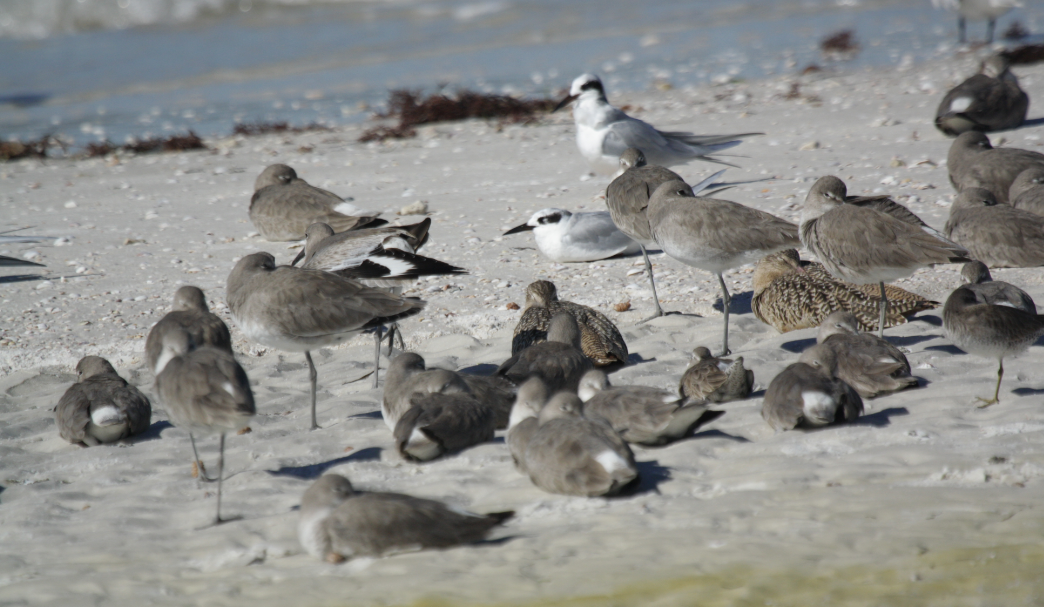
The second half was mostly shorebirds, which was more quantity rather than quality:

Nearly all the birds in this picture are willets (grey, white rump patch) with the exception of the two Forster's terns and the following:

the two brown birds in the center and right-center with the intricate markings are marbled godwits. The small bird on the ground between them, and the darker yellow-legged bird to the far right (it's standing on one leg), are short-billed dowitchers.
The bird with the black and white wing outstretched (left of center) is a willet. These wings markings make these
otherwise nondescript waders quite attractive in flight.
Finishing off this rather bird-packed area was another flock on the eastern side, made of turnstones and a few least sandpipers. It is interesting how the smaller sandpipers will habitually congregate with turnstones but not often with other waders. Perhaps it is because their foraging style is similar.

Turnstone (left) and least sandpiper.
Least sandpiper strutting around the sandy dunes.
Nearby one of the Forster's terns was trying to start arguments. Not sure why. 
Perhaps it was some territorialism that came with the imminency of breeding plumage.
It was a long 3 mile walk back but definitely worth the walk. I wonder how many more birds would be around if there were less people in general? It seems like such a promising place, too bad the main birding area is not accessible by car. Good exercise I suppose.

In the car park was a unusually tame common ground-dove. These tiny doves are generally very hard to approach.


I'd also like to point out this bizarre moth.
A moth: Melanochroia chephise
And did I mention that ospreys are everywhere?


Thursday, January 29, 2015

Chinsegut

Before I take this blog post to its intended destination I will start off by adding a section about Chinsegut Wildlife Center. We found out about this center literally by opening up a map and pointing at it. There was the fear that it was one of those children's education places rather than a real park with content to admire, but it was a good decision. It turned out to be one of the best but overlooked birding areas in the county.

One of the common inhabitants is the red-headed woodpecker, a bird which is quite rare elsewhere in this part of Florida. Other than their appearance at feeders, they are usually invisible and shy, so this at-feeder photograph is the best I have at the moment:


This wooded location also boasts all other Florida woodpeckers except red-cockaded, including the sizeable pileated woodpecker. Pileated is an elusive and skittish species whose laughing call carries far and wide, penetrating an often silent wilderness. Often a single bird is echoed by other in the immediate vicinity, but they are generally uncommon and spread out over large portions of woodland. Naturally it is generally heard far more often than it is seen, the best chances of seeing these birds is hearing one and having the luck to be beside it. Since the presumed loss of the ivory-billed woodpecker, the pileated has now become the largest living species of woodpecker on the continent. And big they are! Far larger than any other American woodpecker, they are quite striking birds if you get a good look at them.


The giant woodpecker comes to light: exceptional views of this secretive shade-loving woodpecker.
In other notes, a bird I've yet to get good photos of is the "yellow" palm warbler. Palm warblers are probably the most abundant bird in Florida during winter, but most of them are the brown "western" subspecies and they turn up everywhere. The yellow palm warbler or "eastern" palm warbler is less common. Whenever I include a yellow palm warbler in my bird sightings ebird gives me the flashing green "RARE Are you sure?" notification. They certainly aren't that rare though, I tend to see at least one in any well-sized palm warbler flock. In some cases nearly half a flock can be yellows. Unfortunately they are very quick to leave the scene and certainly don't stay around long. Too bad.

A passable photo of a "yellow" palm warbler at Chinsegut. Some birds are nearly this yellow, but they are most likely hybrids between the two subspecies. Perhaps next time I'll manage to change my camera settings before it takes off.
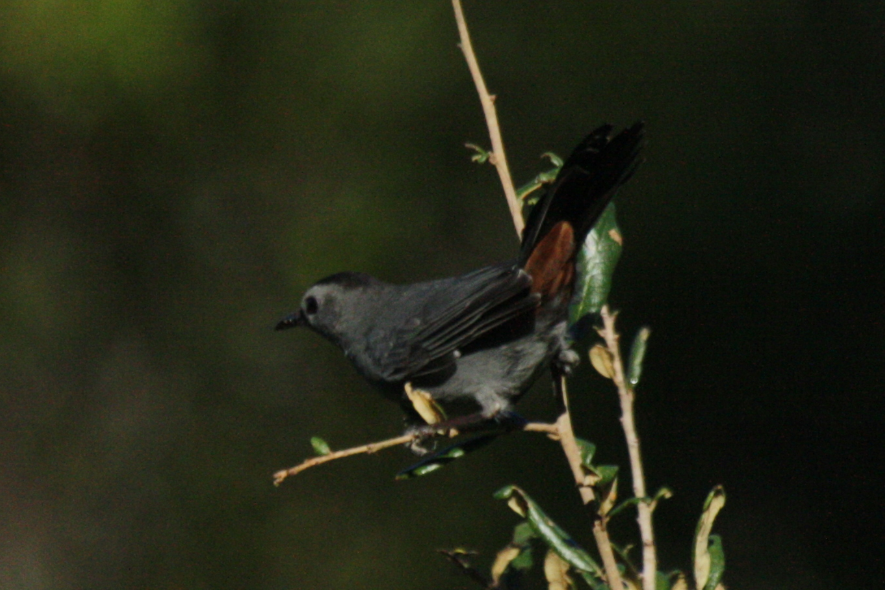
Another winter visitor to Florida is the grey catbird. This skulky bird is named for its raucous call that does not exactly pass as a cat, but I guess I can see where they were coming from. I mention this bird as on this particular visit I had my first actual views of this species when I flushed one while walking past a bush. I was half expecting my first views to be part of a tail or such but in the apparent consternation of being spotted this one seemed to forget that it was meant to be a secretive and invisible bird:


I'd also like to offer a mention to the white-eyed vireo. This species is rarely common anywhere, but in Florida we are lucky enough to have this bird resident all year round. I had my first encounter with the species while getting to grips with its songs and calls on my iPhone during a quiet section of the forest. During one of these playbacks I heard wings in a bush beside me. I raised an eye to this new shadow and there it was! I purposefully had the sound on low to avoid disturbance, but it seems I underestimated avian hearing. The bird had come from well across the forest to seek the mystery intruder.

The pale eye is unique to this particular vireo, at least in America. 

"Now where did that sound come from?"
"Must be here somewhere."
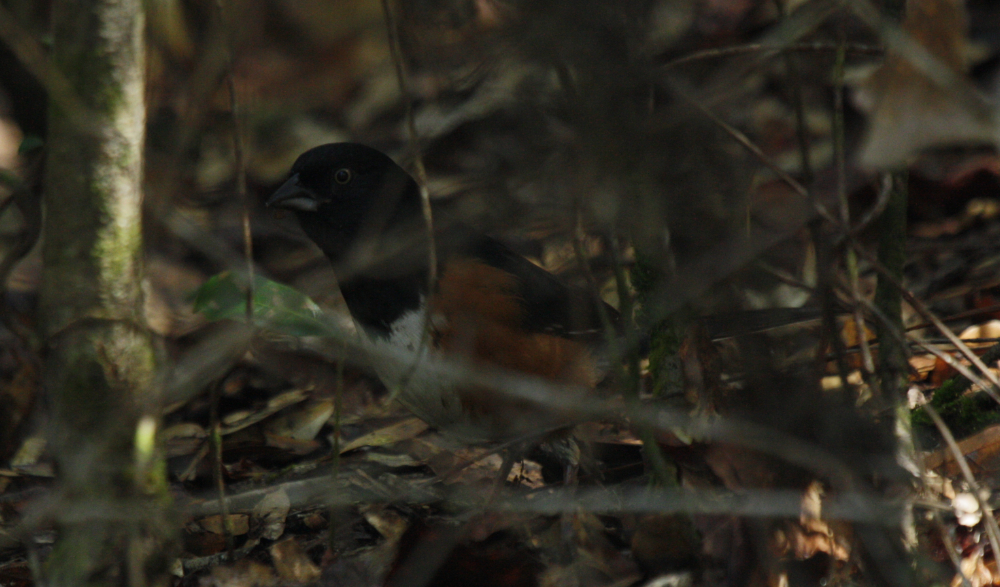
Keeping up with the skulky and pale-eyed theme is the eastern towhee. A cousin to the abundant spotted towhee in California, the unspotted eastern towhee shares the same leaf-kicking behaviour. They don't seem to be as diverse in vocals as spotted towhee, instead they tend to monotonously use the same calls over and over, but an otherwise "nostalgic" bird.

Eastern towhees lurk in shady areas and hedgerows, kicking up leaf litter as they go. They are not usually that flighty, but generally not tame either.

Eastern towhee sneaking around.
This species was once called the rufous-sided towhee when it was merged with the spotted towhee.
Finishing up the skulking theme is the thrush-like warbler named for a nest that it builds on the forest floor. This odd warbler hardly looks like a warbler and is certainly quite different to other members of the family. Unlike the towhee this bird bolts at the slightest sound and often hides in deep cover which makes it rather frustrating to get a good look at. This all assumes you even see the bird dart away to begin with, you are far more likely to walk past it. I now present: the ovenbird.


The final highlight of the day was this stunning yellow-throated warbler that hopped around the windows of the visitor center.