Most people don't expect the amount of birdlife that can be found far out to sea. There are in fact a wide variety of species of terns, petrels, auklets, guillemots, puffins, gannets, albatrosses, and all sorts. Of course that isn't all you've got to see. You can't forget all the whales, dolphins, seals and other interesting sea creatures you would never expect to see in your life.
One of the most important things noted on this trip was the correct pronunciation of "pelagic", which was neither p-la-jic or p-lay-jic, but p-lar-jic. With a camera as short as mine you can't help but worry that those specks on the horizon will be no more than that in the pictures. Yet, hearing the stories of the great rarities flying over the boat at no more than mast height, and the skuas flying right off the stern, I quickly forgot about that.
And yes, boat terminology. It is one of those things people always forget unless their father is a sailor. It was infrequently used in the trip, but you could still come home remembering it simply because you
wanted to know it just in case the guy on the PA decided to pass it over to someone that thought starboard sounded better than 9'oclock or right side. Those crucial seconds between figuring out the direction could mean the difference between missing it and seeing it. But of course it was nothing like that. Not a lot anyway. Occasionally the boat terminology was used, and there were always the odd people pointing the binos in the wrong direction. At the same time the guy on the PA also mixed up left and right a few times.
"Sorry, that's left." Was not an infrequent message, similarly was "That would be Common Loon, that's why Matt is my mammal guy and not my bird guy!"

So at 7:30am there I was on the dock. A Great Blue Heron was perched right by the dock on a boat. One of tour guides by the name of Wes approached me and scratched his head. "You got a jacket?"
As it happened I didn't. I did, but it was not here. My parents convinced me I would not need one on the sunny seas of California.
"Well if this is your first time...you're going to regret it. The boat runs at 30."
At that time I certainly made an effort to check if there were any for hire. I could have bought one, but $45 was not something I had or wanted to spend today. Luckily a very nice person happened to overhear and kindly offered her spare one. Good thing too. The same person happened to point out some Black Skimmers on the beach amongst the gulls. I did check the flock briefly before but did not see them then. In case you don't know, they are the black and white birds with the strange orange bills.
On the boat while waiting a Great-tailed Grackle flew over. However I was too busy trying to work out what the long-tailed crow was and did not get a picture. This is proof of my ultimate weakness, which is spending way too much time trying to work out what things are and not enough time taking pictures. Shoot before you think is not something I am really born with.
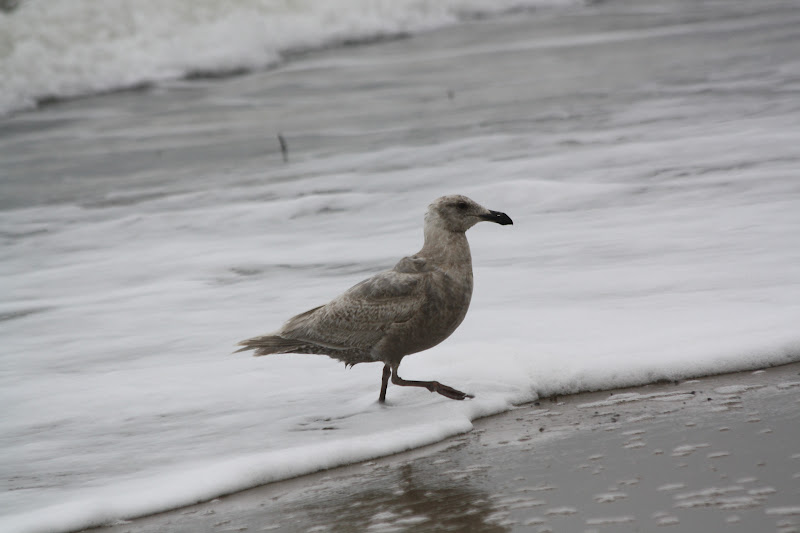
It came to 8:00am, and finally the boat started moving. The captain presented himself and the crew and started by pointing out the Black Skimmers amongst the Western, Heermann's and the odd California gulls on the beach (The California gulls are pale grey on the back as opposed to dark; there is one adult past halfway visible in the picture above by itself) and we were on our way.

It was not long before a
Parasitic Jaegar (EU: Arctic Skua) passed behind the boat, with the beach still very close. Jaegars (Pronounciation yay-gr) are a very widespread, but not too common, group of sea birds. If you were to ask me what they were "like" I couldn't answer. They are not like anything. Jaegars are like Jaegars. The flight is seagull-ish but other than that it is completely unique. Jaegar is purely an American term; in Europe the group is known as Skuas. Calling them Jaegars makes some sense, because the physically different South Polar and Great Skuas are already called Skuas. The "Jaegars" in comparison are very small and very different, so it makes sense to call them something different. Its like calling a Magpie a Crow. Sightings from the shore are fairly rare, and this bird could have definately been seen from the shore if you were in the right place. It was distant but you can identify the details at least at full size. I don't believe Blogger lets you see the whole size when you open it, at least not on my screen. Click on the picture below to see a crop at full size. It has not been resized at all, just some of the background has been cut off.

The first
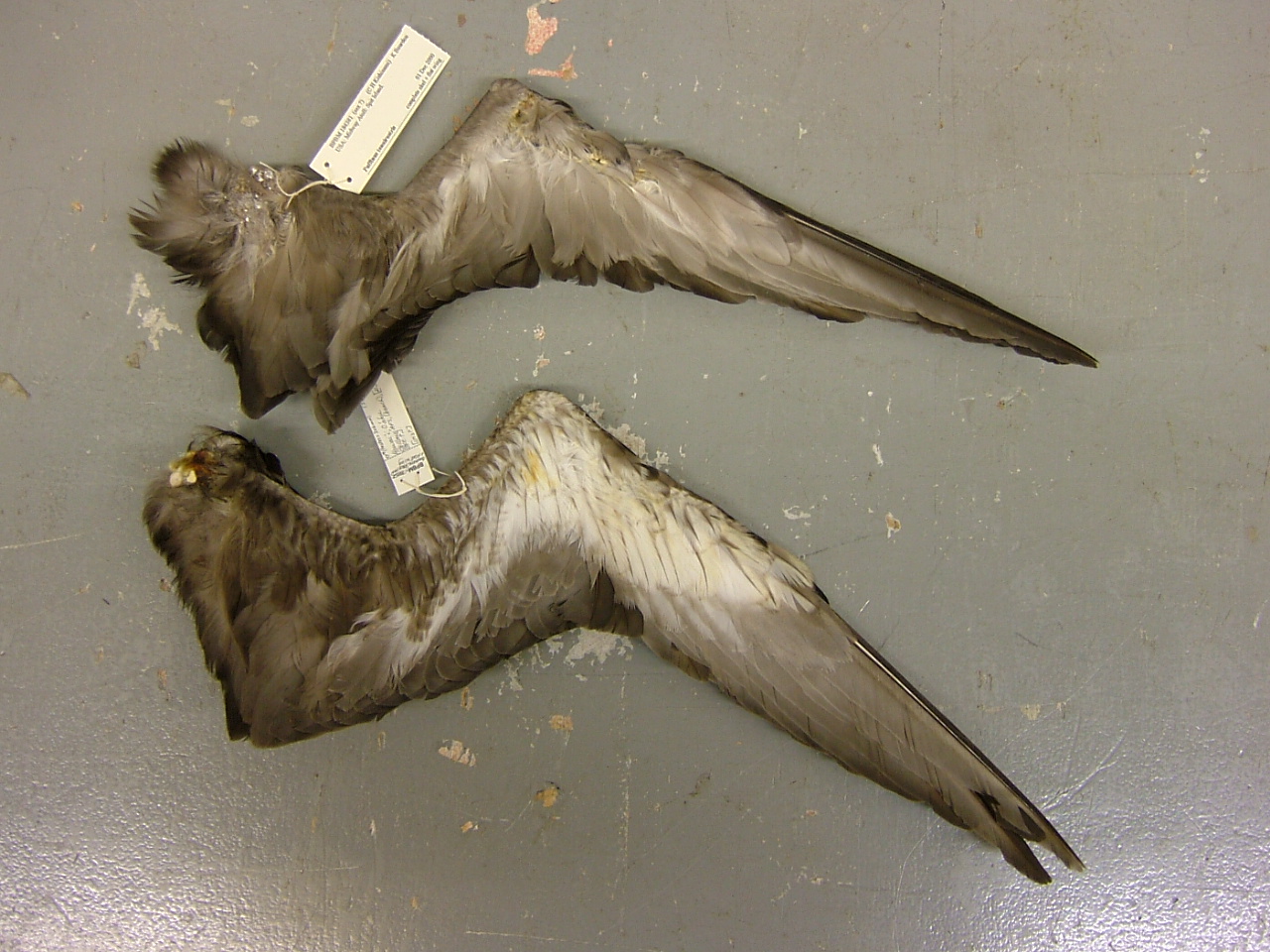
Sooty Shearwater came by soon after. No pictures are this point because I have much better ones later. The are very dark gull sized birds with pointed wings. For a pictoral reference, they look like the Jaegar above but are completely dark, have longer wings and a longer beak. The Sooty is a close cousin of the only pelagic bird I have seen, which was the Short-tailed Shearwater that washed up on the Arctic Tern event back in Australia. Sometimes they are unseperable, but the Sooty is generally told by the white under its wings. The Sooty is generally pale brown in this area. See this image
here. (Sooty is the bottom wing). Shearwaters have a very distinctive flight. They generally flap five to seven times and then glide very close to the water surface and then repeat. Consult this ten econd (as in it took ten seconds to make, not representing ten seconds) diagram:

After that came a few funny little grey birds whizzing by very close. They were
Red-necked Phalaropes, a very, very tiny pelagic shorebird. While they don't seem to be anything like Sandpipers in any ways, they are actually in the same family. Phalaropes don't even walk on the shore like all the other shorebirds. They swim out in the deep parts of lakes in the summer, and out at sea after August, foraging on whatevers around. Again, no pictures now because they are terrible at least compared to ones I have later on.

A cormorant passing by was a
Brandt's Cormorant for a change. I was certainly happy to see a cormorant that was not Double-crested. I saw them at regular intervals, but I still didn't get a good picture of them probably because they were generally overshadowed by other birds. A Red-necked Phalarope perching on some kelp was the only shot I got of them sitting. This bird was peculiar as it did not fly when the boat came by; they are generally very skittish. The boat was not stopped for this one as they started to pop up all over the place, hence the motion blur.
A little fin popped up nearby and vanished instantly. "Minke Whale" was on the PA and there was a sudden influx of cameras on the right side. Unfourtunately this "slinky Minke" could not be seen again. Minke Whales are notorious for abruptly vanishing.
While on a pelagic trip you better get used to seeing this sight, because it is very common when no birds are around:
The first Pink-footed Shearwater appeared, followed by many others, amongst Sooties. Apparently Pink-footed have a slower wingbeat but after seeing each species in the hundreds I was still struggling to seperate them. It was a good thing there were other differences. This picture (and a cropped one in case you can't make it out) shows why they are called Pink-footed.


A
Northern Fulmar also appeared well out and my only shot was it flying away. This bird was a dark morph. Northern Fulmars (called Fulmar in Europe) have three colourations: light morph which is entirely white, the dark morph which is dark, and the intermediate morph which is in-between. Strangely while its the same species as the European bird, I do not remember them having a dark morph in the U.K. Fulmars are not closely related to gulls but can easily be mistaken for them. They are actually Petrels, which can be told by their wing shape and the naricorn (the funny bit on the top of their bill), but unlike other petrels they are not as
cute in appearance. Their name comes from some old language (I forget which) meaning Distasteful (Ful) Seagull (mar) which is a reference to the bad-smelling oil they use in defense like other petrels when handled, not too unlike the typically orange-coloured liquid used by ladybirds.


The deck then sprung into action as a
Pomarine Jaegar was announced on the PA. It had appeared in a flock of Shearwaters off the bow in a feeding frenzy, though it did not sit on the water at all. The bird made several passes which was more than enough for the cameras, but it was unfortunate about the lack of sun. I have no idea why everyone was so enthusiastic about this bird, because there must have been at least eight of them throughout the entire trip. So far that meant I had two of the three Jaegar species, the missing one being the little Long-tailed, which was definately possible on this trip. Also present were some fairly distant Long-beaked Common Dolphins. I have no idea how the "mammal guy" came to a conclusion they were Long-beaked; the two Common Dolphin spp. are virtually identical. Normally range is the key to seperation but California is one of the few places where they are together. Unfourtunately they were the only ones on the entire trip.


Here are some more Pink-footed Shearwaters.
And this is when you finally get to see the Sooty Shearwater hellishly close to the boat and in the water. Told you I had better shots.
All of a sudden there was another frenzy with Cassin's Auklet announced on the P.A. It took a great deal of finding. This picture is pretty much what I saw.
So there was the situation. A bird the same colour and the same size as the shadows and ripples, and flying by at a blazing fast speed. It was undescribably difficult to find and keep in sight.
If you had an amazing lens and could somehow keep the hefty equipment on it at the same time, this is probably what you saw.
Or if you were with a kit lens like myself, then you saw this.
The first image is a crop of the above.
I bet the majority of people didn't even see it quick enough. And it was as small as its looks. The bird itself is not too much dissimilar in size to a tennis ball.
That brings me to another topic; cameras. Virtually everyone had one of the following: Canon 7D with the same lens as mine, the exact same camera and lens as me (Canon 1000D + 75-300mm kit lens), the same camera as me but the lens I want for christmas (Canon 100-400mm IS), or some ridiculously extraordinary huge lens that cost you a pact with the devil (only two people of the thirty-five or so). I was actually surprised to see so many with a camera as basic as mine. At least I knew not too many people were getting better shots than me, and some people even had very basic SLR cameras that would have been no more than $100-200.
I am happy with a photo if it has a bird in it, and its not a tiny unidentifiable dot. Luckily with my current camera I can take a photo as such as size that what would have been an unidentifiable dot on my older camera is clearly visible at full size thanks to the image size I can take which more than makes up for a slight decrease in focal length which was slightly better on my old Panasonic. Even better, despite the apparent terrible quality on the crop; it is still identifiable to species without much effort (the white stripe on the underwing), even though the Auklet group are very similar.

The sea up to this point had been fairly calm, and it had actually stayed that way throughout the entire trip save one random wave that splashed everyone who happened to be on deck (not too many cameras out I hope). But even though it was calm it was still fairly difficult staying still. There were a lot of people loosing balance.


Another Northern Fulmar, this time an intermediate type, hurriedly took off as the boat came closer. This intermediate bird clearly showed its butterfly-like patterning and petrel-like tendency to water-walk.

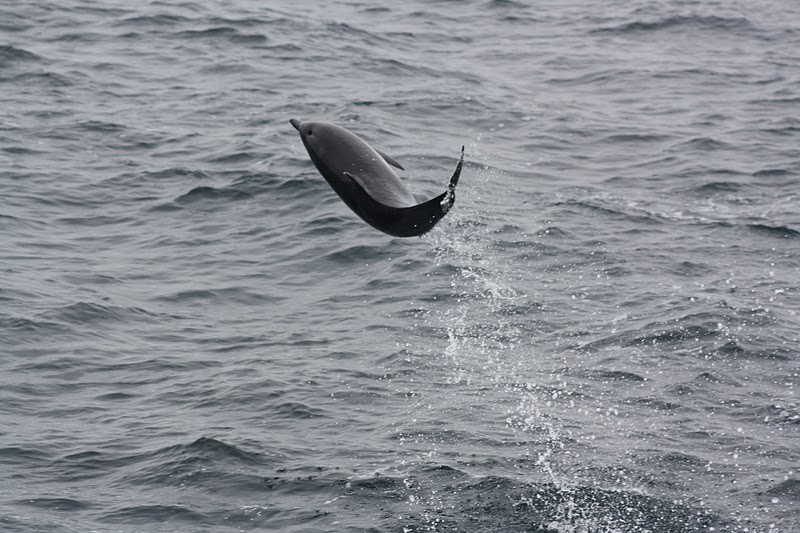
Up ahead was another frenzied flock of Shearwaters and in the hope of finding two other Shearwater species the course was set. Upon arrival there was not Long-beaked but Short-beaked Common Dolphins. When I heard how difficult it was to photograph dolphins I was one of those "yeah, right" people. But in today's conditions, when you could not see them underwater it really was a shoot-and-hope-there's-a-dolphin scenario. My shutter speed was not fast enough to rely on it manually (I would just get the tail) and there were so many surfacing at once (photographer's reflex not helping i.e. waiting for movement then shooting) hence why many shots are off-center. In the below picture there are a few young individuals.


A certain energetic individual was doing a good job drawing the crowds with "oohs" and "aahs". In case you were confused, in the first image you are seeing the top of it (the fin on the left is the dorsal fin on the back and the fin on the right (not the tail) is the right pectoral fin). Both images are from the same leap.
As usual there were uncountable quantities of Pink-footed and Sooty (pictured) Shearwaters, but no sign of Buller's or Black-vented.
Another Brandt's Cormorant:
And a Brown Pelican very close to the boat.

At the next stop a Northern Shoveler appeared. You may be thinking from the Pelican shot that there is land so we can't be that far out too sea, but that is actually one of the Californian Channel Islands (Santa Cruz Island). And I'm sure there is some water there but the islands are very small; any kind of duck is an oddity out to sea unless its a Scoter, Merganser or Eider.
There was quite a sizeable concentration of Red-necked Phalarope here. The photo only shows some; most had flown off already.

Risso's Dolphin soon followed. Unlike the other dolphins, they were on the surface quite a lot so getting a picture was easy. However all they tended to show on this occasion was the fin. Risso's is a round headed squid-eating dolphin that does not have the beak of the typical species, and the dorsal fin is very long and curved which is a feature I could easily tell from a distance. I was happier to get this one because it is a deep-water species that is very rarely seen except well offshore and even then they can be hard to find. They are mostly dark grey, but can appear white because of scratches and scars. I have no idea what these scratches come from, but they accumulate an awful lot of them. All I can find is that their sensitive skin does not regenerate pigment when scratched from playing with other dolphins and squid and thus lasts them their entire life. Unless they were biting each other I can't really imagine this happening, and I always thought squid(s?) were soft and squishy but doing some research it seems a squid bite is worse than a pair of scissors.


About ten minutes on another pod of tenative Risso's were actually some Bottlenose Dolphins, a species that is not so common off-shore. There seemed to be some individual variation in fin shape which I did not expect to see as each dolphin type tends to have a unique falcate shape. This made four different dolphin species already which was not bad even on a whale-watching trip.


Before anyone knew it the dolphins had dispersed behind the boat and set up a pace. At the same time the P.A. came on with "Blue Shark off back". About two hundred metres ahead was a distinct triangular fin breaching the surface. As soon as the dolphins were there the fin abruptly vanished. Dolphins have a tendency to scare off sharks, but I don't think anyone expected it. There was a very narrow gap between finding the shark and taking pictures. It is near the top of the image (the splashing at the bottom is dolphins). I didn't expect to see Blue Shark here, as I was used to it being an Atlantic sea species but apparently it is in both sides.


Leaving that behind the boat sped up ahead and slowed down again with a
Rhinoceros Auklet in the waters off the left side of the boat. This bird has a tendency to look very dull and non-descript at a distance, but it is actually rather colourful. Funnily enough this bird was very dull and non-descript as it was a firt summer (immature) bird. Yes, unfortunately only adults are colourful.
The boat sped up and slowed again shortly after, this time there was a dark morph Northern Fulmar very close to the boat. I finally got some good pictures of this bird. At a distance it can look very shearwater-ish but is not that closely related (but is in the same family) and even shares the flight as seen in the diagram earlier on. Close up it is easy to see the differences. The head is rounder and more petrel like and the naricorn (nostril) is easily seen on the top of the pale bill which itself is very unlike the shearwaters.
Red-necked Phalaropes soon started appaearing again off the left side of the boat.
Then "Red Phalarope at 9" came on the PA. There was a rush to get to the right side and sure enough a slightly larger but just as fast Phalarope had appeared. After the trip I wasn't sure whether he actually said Red Phalarope as I could not find any in my photos and I actually removed it off the trip list for a while, but sure enough after intensive looking through I did find the picture:
The Red Phalarope is called the Grey Phalarope in the U.K. and surrounding Europe (theres a rumour going around that Europe accepted Red now). The two names are quite amusing, because they both represent different plumages. In summer the Red Phalarope is entirely red with a white patch on the eye. In winter it is entirely grey like the bird here. It comes down to whether people want their special Phalarope named after its summer or winter plumage, or give it a completely different name altogether.
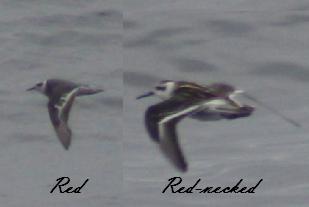
The Red can easily be mixed up with the Red-necked at a distance like the bird here, but there are several differences. It (Red) is much larger than the Red-necked, though as the Red was on the other side of the boat to the Red-necked flocks this was not helpful. The most reliable difference is the patterning on the back and the colour on the crown of the head. In the Red, the back is grey and in the Red-necked it is streaked with a multitude of colours. The Red-necked has a black cap and the Red has a faint grey smudge there. The former feature is obvious in this comparison shot, the latter not so.
The Red Phalarope is fairly uncommon off the Pacific coast, so it was a great bird to get.


Later on sitting on a floating Sargassum (floating seaweed) was a juvenile Common Tern. Not something I expected to see this far out, but apparently regular. Also here were four Common Loons. Originally these were identified as something else, but I couldn't make out what the PA was saying. There was some confusion and muttering amongst the birders. Sure enough this is where that quote from the start should be inserted.
"That would be Common Loon, that's why Matt is my mammal guy and not my bird guy!"
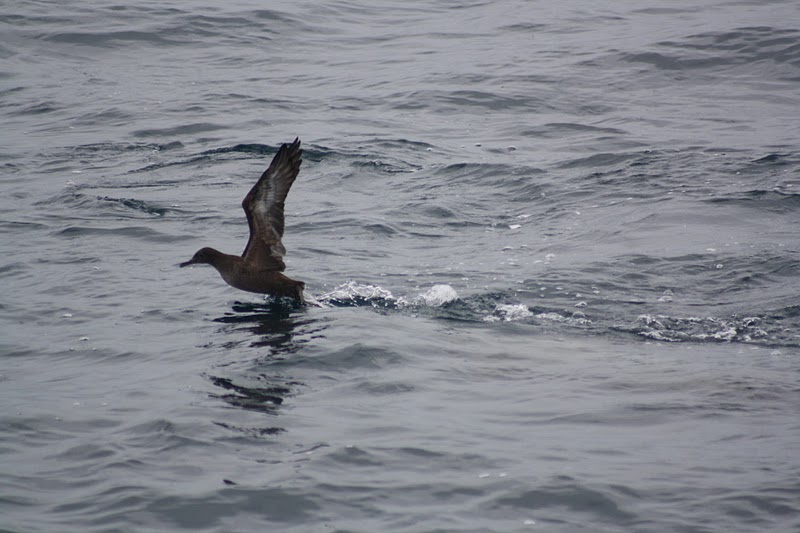
More Sooty Shearwaters taking off.
A few minutes on and "SKUA at 6, BEHIND THE BOAT. SKUA. SOUTH POLAR SKUA OFF THE BACK!" alerted the whole deck into yet another frenzy. At first I thought he was making a reference to the kitchen utensil (skewer) despite the fact that out here the bird is 99% more likely, but I was soon turned around when I realised what was actually said.
Well off in the distance was a dark morph South Polar Skua, one of the largest sea birds, and an uncommon winter migrant down in California.
I'm assuming by the activity that it was extra uncommon down here.
The next destination was to be off Santa Rosa Island where a giant flock of Storm-petrels (called a raft) has been for the past few months. As we came closer sure enough it could be seen.
There are two species of Storm-petrels here; Ashy and Black. The two are virtually identical and with these skittish birds it is almost impossible to approach them. If the boat came within two hundred metres then the original flock (first image) scattered (second image). Bait was put out in hope that they would come but only one strayed that close, and that was a single Black Storm-petrel. Apparently there was an uncharacteristic lack of Ashy Storm-petrel in the flock according to the tour guides.
There was some rumours about an Ashy, but it was too far even for the best cameras. At least taking pictures of the whole flock guaranteed both species. Up ahead, was something I don't think anyone expected.
It was an Ocean Sunfish.
A second Sunfish appeared later on as did the best candidate for an Ashy Storm-petrel. The back seemed greyish, but I don't think it can be seen unless its at full size, which Blogger does not seem to show even when you click on it.


More Risso's Dolphins showed themselves, this time a lot closer to the boat. The scratches are clearly evident. Remember that they are dark grey; the "white" individual is heavily scarred. The darker individual with a stylish three stripe scratch on its dorsal fin is likely younger because obviously more exposure = more scratches. If each scratch is one squid, then it shows not only that they encounter a lot of squid(s?) but that squids are definately not as cute and squishy as they make out to be. They apparently have a large appetite when compared to other dolphin and pilot whales.
Another Common (or at least "Commic") Tern was seen behind the boat. Commic is a tern used when there is no true agreement between if the bird is a Common or an Arctic; two rather similar species.
On approach to San Miguel Island another pod of Long-beaked Common Dolphins made an appearance with more shearwaters, but still no Black-vented or Buller's. This was probably my best shot so far of a Long-beaked Common. If only it was a little to the left.


On approach to San Miguel Island, we could see its distinctive arch that was somehwat but not really remniscent of the Needles of the Isle of Wight. The sun started to appear as we came closer.

We were being told about Sea lions but it wasn't until the boat was really close that they could be seen. Camouflage was well at work here.
Somewhere in this picture is a Black Oystercatcher. Its red bill should make it easy to find. It was very hard to find in the viewfinder, let alone naked eye.


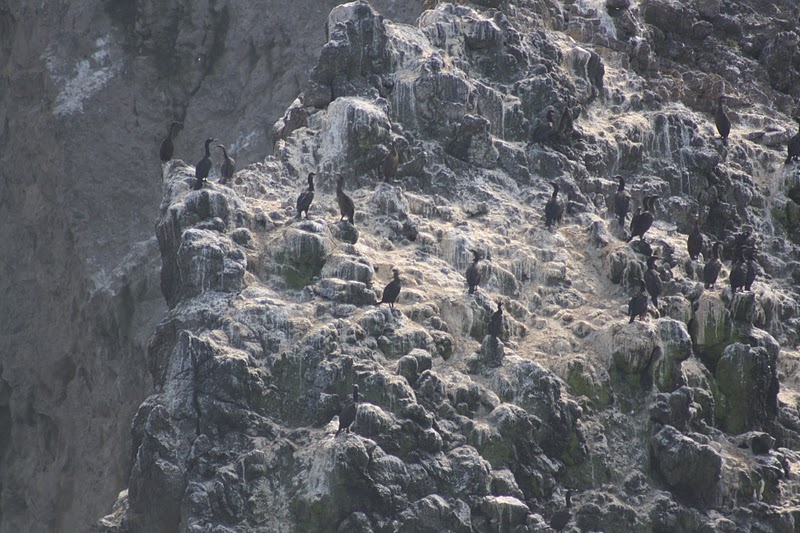
Also noted were Pelagic Cormorants. Pelagic Cormorants are a skinny version of Brandt's but can be still be hard to seperate. I don't think I got the pictures of the bird in question, because with all the Brandt's flying around it was not easy. However around the cliff was a large cormorant colony and I have managed to find at least 2
Pelagic Cormorants. In the original image they are on the top left side next to a Brandt giving a good comparison of the neck thickness difference.
Brown Pelicans came very close to the boat as we left San Miguel.
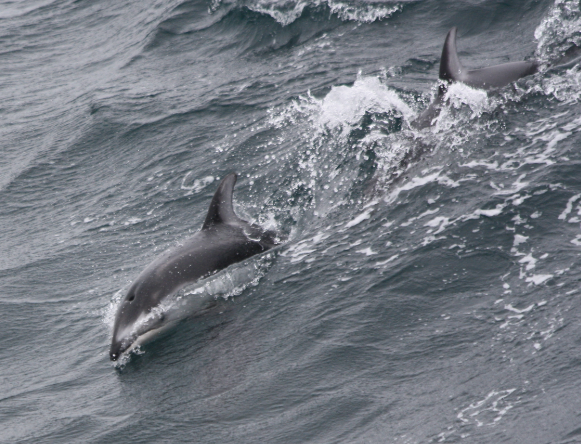
Further from San Miguel was a monster group of Common Dolphins. Since the water was calm I guarantee every splash is a dolphin. I could not fit them all in one photo.
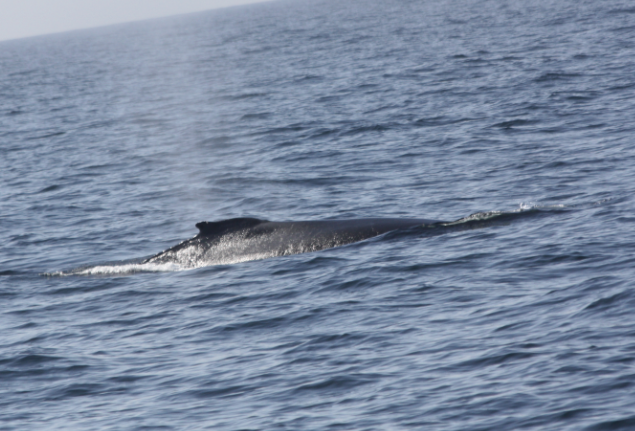
The whole way back to Santa Barbara it was strangely silent, especially considering the ton of activity experienced on the way. However as we neared a little fin popped up behind. "Minke Whale off the stern, possibly same individual from before."
However very few payed any attention and as soon as the fin was gone there was no onlookers apart from myself. Luckily for me it came up again rather unexpectedly. I was the only person looking in this direction, so I'm assuming I was the only person to get a decent look at it. A few others caught on when they saw me with the camera up, but they were far too late.
Red-necked Phalaropes were absolutely everywhere as we neared the dock.
Another Pomarine Jaegar was the last "pelagic" bird seen. A Whimbrel had appeared on a sandbar opposite the Black Skimmers from before. The latter had vanished, so there went my plan of getting a closer look on foot. In the dock Double-crested (AKA the regular North American cormorant) cormorant was sitting very close to the boat giving good looks.
Back by the car park was a little lagoon. I checked it for sandpipers and found a few Killdeer. Then I noticed a tiny little bird below them on the same side of the lagoon.
It was a Western Sandpiper, my first ever peep (Peep = one of those notoriously difficult to identify North American sandpipers in genus Calidris) in three years of living in North America. Long overdue if you ask me.
Not a bad end to the day. The trip report took 5 hours to type (12-5pm), so hopefully it is appreciated!
17 lifers. 18 if you include the missed Grackle.
| : | 9/17/2011 |
| : | 95520 |
| : | Published in Atlas |
| : | James Bailey |
| : | 29 |
| Species | Scientific Name | Count | Comment |
| Northern Shoveler | Anas clypeata | 1 | Female/eclipse male well out to sea. |
| Common Loon | Gavia immer | 4 | Non-breeding birds. |
| Northern Fulmar | Fulmarus glacialis | | Dark and intermediate morphs. |
| Pink-footed Shearwater | Puffinus creatopus | | Many, but mostly further out to sea. |
| Sooty Shearwater | Puffinus griseus | | Many. |
| Ashy Storm-Petrel | Oceanodroma homochroa | 4 | Very few. |
| Black Storm-Petrel | Oceanodroma melania | | Large flocks. |
| Brandt's Cormorant | Phalacrocorax penicillatus | | |
| Double-crested Cormorant | Phalacrocorax auritus | | |
| Pelagic Cormorant | Phalacrocorax pelagicus | | Possible birds off San Miguel. |
| Brown Pelican | Pelecanus occidentalis | | |
| Great Blue Heron | Ardea herodias | 2 | |
| Snowy Egret | Egretta thula | 3 | At dock in Santa Barbara. |
| Black Oystercatcher | Haematopus bachmani | 2 | San Miguel Island. |
| Whimbrel | Numenius phaeopus | 1 | At dock in Santa Barbara. |
| Red-necked Phalarope | Phalaropus lobatus | | Many close to Santa Barbara dock. |
| Red Phalarope | Phalaropus fulicarius | 1 | |
| Heermann's Gull | Larus heermanni | | More abundant than Westerns. |
| Western Gull | Larus occidentalis | | |
| California Gull | Larus californicus | 1 | San Miguel Island. Pale grey back and yellow feet. |
| Common Tern | Sterna hirundo | 2 | |
| Elegant Tern | Thalasseus elegans | 1 | At dock in Santa Barbara. |
| Black Skimmer | Rynchops niger | 12 | At dock in Santa Barbara. |
| South Polar Skua | Stercorarius maccormicki | 1 | Dark morph. |
| Pomarine Jaeger | Stercorarius pomarinus | | |
| Parasitic Jaeger | Stercorarius parasiticus | 2 | All near Santa Barbara early on. |
| Cassin's Auklet | Ptychoramphus aleuticus | 1 | |
| Rhinoceros Auklet | Cerorhinca monocerata | 1 | 1st summer. |
| Great-tailed Grackle | Quiscalus mexicanus | 1 | Dock in Santa Barbara. |