Oak Canyon Community Park
________________________________________________________
Ring-necked Duck, Hermit Thrush
Total: 2
Another simple visit to a nearby location today. I certainly had hope that the duck pond would one day hold something more wild, as opposed to the hundreds of domestic (and probably wild) Mallards there.

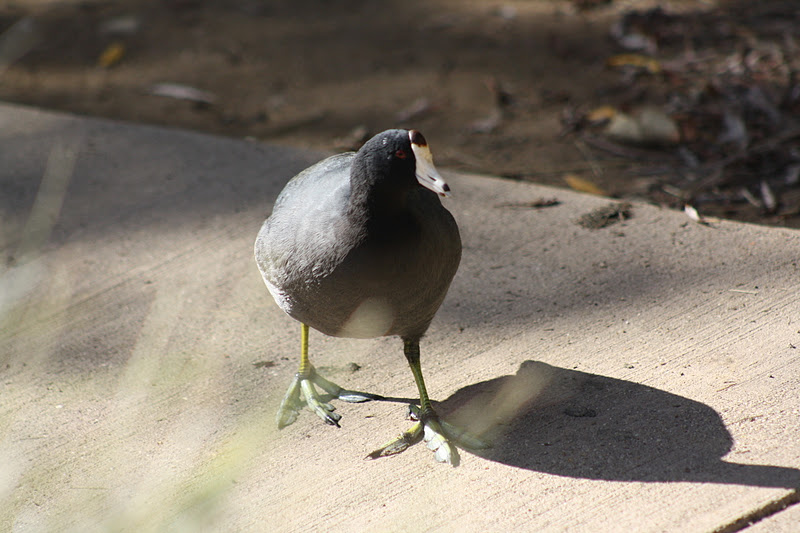
The first bird I saw, other than the Mallards, was an American Coot. This is the first time I've really seen this bird here. The first time I ever saw this bird was in Alberta, and at that time it was very far off in the distance. This one however, actually came out of the water and waddled over to my feet. I guess they get fed too. In fact they came so close I had problem focusing which is clearly seen on the walking birds below.


The American Coot is one of many different Coot species in the world, and the American has occasionally turned up even in the U.K. Most people would wonder how an earth you tell the two apart, because at first glance they appear identical, but there are two static differences, both around the bill, that do not vary (in adults that is). Compared to some European-American pairs like these two, all you have to do here is check the bill. No need for getting obscure looks at a certain wing feather, or counting how many plumes are in its tail hoping that there's a slim chance it will fan its tail when preening.

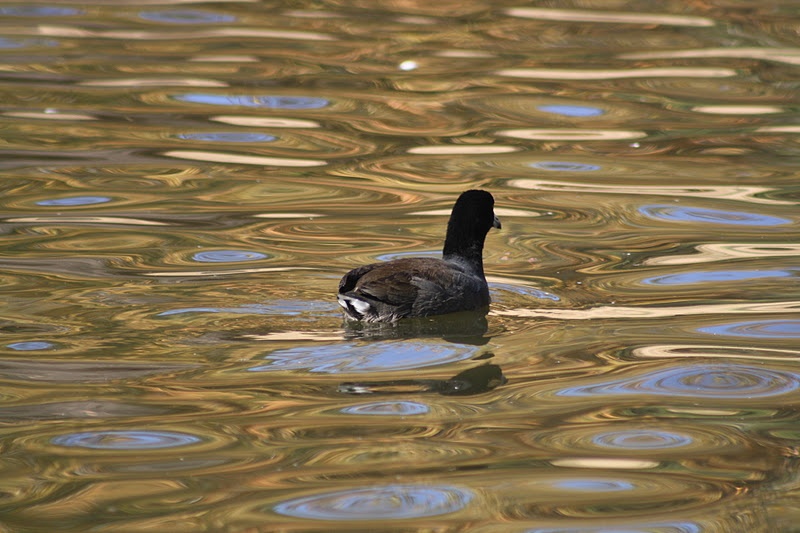
At the right angle the water had managed to conjure up a very interesting effect in the background. I'm not even sure how physics made it look like this.
Getting back to the birds, the Mallards here are a unique bunch. Half of them are obviously domestic, with extravagant shapes, colouring and proportions. The other half look perfectly wild. Problem is there is not really any way to tell. Luckily Mallards are common in the wild, and it isn't hard to find a perfectly wild bird somewhere else.
All this time there was a fairly large sized group of ducks at the back that kept their distance from the mixed-origin Mallards. I payed little attention to them at the start for whatever reason, but once I was on the other side of the lake I didn't hesitate to get a look at them. They were very skittish when compared to the Mallards, and they kept a distance no matter how I tried to get around them. When I first caught onto their appearance and got a good look at them I very quickly searched for a female to base my ID on (the brown females have far more differences when compared to scaups). As expected they had the bridled eye, and a distinct pale brown patch around the base of the bill.
And they were Ring-necked Ducks, about 22 in total. A scaup relative that has become one of the few ducks I had yet to see in North America. Ring-necks are a true wild duck that has California as its migration route. The chance of them coming from captivity? Around 0%.
I was very happy to finally pick up this handsome looking bird. In Alberta they were harder to come by, as they stuck to the lakes of the wilderness, which despite my somewhat lengthy stay there I had yet to see (a lake of that description that is).
Ring-necks' name is a bit of a paradox in a way. Reopen the first image and take a look at the bird on the right. Look closely and you'll see a sort of brownish-maroonish ring around the neck. It's a bit hard to see, but it's there. Now I was constantly referring them accidentally as Ring-billed Ducks, for obvious reasons. The white band on the bill is significantly easier to see, and no other duck has it. And why aren't they called Ring-billed Ducks? The name hasn't been used yet. It's like calling a Blue Tit the Green-backed Tit instead.
I'm sure when I said that someone reading this had gone to find a picture of a Blue Tit to check it. If you didn't, then I expect after reading this sentence you will be.
Since the start a few Yellow-rumped Warblers (all Audubon's) had been flitting about in the maple sp. trees around the park, but only one was really picture friendly, and it deserved some pictures.
All of them were in basic (non-breeding) plumage which is a typical sight in California, where they appear throughout the entire winter. They get a lot prettier than this during the summer.
At the back of the lake is a patch of reeds. While too small to be anything larger than a micro-habitat, migrating wetland birds will flock to these sites like moths to a light. During Canada an even smaller patch of reeds managed somehow to home a Marsh Wren and a Wilson's Snipe during such a time period. As a general rule, most reed-inhabiting are very stubborn, and even if the patch of reeds is no more than a square metre you would literally have to pull out whatever it is to actually get it to move. Obviously I wouldn't do that, but there are other tricks.
Pishing; little skulking birds are very curious. And it doesn't have to be "pishing". Any clicks, or whistles even have the tendency to do the job. It depends on the bird. Pishing is simply making squeaking sounds via pursed lips. And it works. It really does work. Within seconds a silent patch of reeds with only the rustling of nearby trees to be heard, came the alarm call of a Common Yellowthroat, which shortly escaped its cover and into a bush nearby to see where the sound was coming from (which normally happens during its flight when it can see everything). But that is normally all you get. There are three things that can happen:
1-The bird, and the other birds nearby, completely hide and make themselves invisible for the remainder of the trip.
2-The bird pokes it head out and resumes its skulking buisness, or flies to more cover to check whats happening as it did here.
3-The bird jumps to an exposed perch where it can get a good look and stays there provided you don't move.
Option 3 is always the best, but it doesn't happen that often. Option 2 depends on many factors. If the bird can see you perfectly fine by simply putting its eye against a gap in the leaves, then don't expect it to fly out. The best way to get Option 3 is to try and hide yourself. If you bird can't see you then it is still curious, and it will keep coming out until it does.
I have seen Common Yellowthroats before, but it is not a bird to shun. It's rather attractive if you can get a good look at it (which rarely happens...).
There was little else around here. There were no Marsh Wrens, Nelson's Sparrows or Soras (at least not that I could see/hear) in the reeds this time around, so I decided to run through some other parts of the park I had not really had a detailed look around yet.
A short walk in the forest behind the lake revealed a charming little creek, complete with yellow-leaved trees, partly-leafless trees. It was a genuine autumn sight, and if I didn't only have my telephoto lens I would have taken some pics of it.
It was well-lit, and the trees were perfect. So I decided to do a bit of migrant surveying. I stood around for about two minutes, heard nothing, so started to try a bit of pishing. After a few seconds I was alerted to a rustle in a bush beside me, and sure enough something was perched there.


From where I was I could only see a part of it, as this particular bush was very dense. Luckily I was able to maneuver around and start to get a better idea of what it is. It was completely still the whole time, probably hoping I hadn't seen it yet.

I started to see speckling on the throat and all the way down the chest, which only confirmed my suspicions it was a thrush of some sort. It seemed small, so I was really hoping for a Veery, which is a very unique thrush. I stepped a little closer in hope that it would fly to a more exposed perch, and it did. It was in the shade, but it was very close, the latter more or less winning over (no point having a bird in the sun if its only a speck on the screen). It was all I needed to work out what it was. The
Hermit Thrush is an oddity to most (I imagine; it is to me), especially if you have lived in Europe. All the thrushes there, the Blackbird, Song/Mistle, Fieldfare, Redwing and Ring Ouzel tend to dislike cover and do not hesitate to perch in the open. The Hermit Thrush however is a complete skulker, and dwells only in shade, shade and more shade. If I didn't catch onto that single rustle I never would have seen it, and to think it was less than a metre away. The Hermit also flicks its tail a lot, which I've never seen in any other thrush before.

This somewhat common bird has eluded me until today, and I must have walked past them all the time, because as soon as it flew from it's dully-lit perch I could not relocate it, despite it landing in a second bush within clear sight of me. As a ground dwelling bird they tend to run instead of fly. A thrush that's harder to see than a warbler...I didn't think such a bird existed. Perhaps some time ago it was the descendant to the modern-day Veery, which has managed to ascend to the Parulid warbler clan.
I decided to call off the search, because I had some good shots as it is, and chances are it had skulked its way to the other side of the forest by now, though I did hear some whistling calls that were very reminiscent of a european Blackbird nearby and can't have come from anything else.
Seconds later a decently-sized Accipter (default around here is Cooper's) had flown right over my head and landed into a patch of trees. If it stayed a second longer I could have got my first ever good look at these elusive forest hawks, but it was not to be. This is the second I have seen so far, and the first I saw was also here. The Cooper's has a much larger cousin known as the Sharp-shinned, which occur here as uncommon winter migrants, but are virtually inseparable save for the shape of their (frequently molting...) tail and overall size. If I had to estimate, I'd say there was a 15% chance it was a Sharp-shinned, which is another bird I have yet to see. It definitely seemed big, but if it was then it would be on my missed birds list, which I do not like to add to!
Back at the duck pond a party of about seven White-crowned Sparrows had appeared in the leafless bushes and were very obliging.
We were about to return home, but instead I was able to look around the "Water Park" area of this location, which has offered some good birds in the past. Apart from the regulars the only interesting bird was a type of woodpecker known as the Northern Flicker (ssp. aureus) that came over the trees. I have seen three in this country so far (2 ssp. aureus, 1 ssp. cafer), all three appearing erratically over my head in random patches of trees, and all three somehow managing to vanish as I turned my camera off (!). They are very attractive birds for the woodpecker family overall,
if you can get a good look at them that is. I wasn't too concerned because I have good images from Alberta, but only of the Yellow-shafted race (aureus), so I'll be keeping an eye out for a Red-shafted in the mean time.
: | 23/11/2011 |
: | United States of America: California |
: | Oak Canyon Community Park |
: | 34°11'08"N 118°46'19"W |
: | 20 |
: | http://www.eremaea.com/Lists.aspx?List=102284 |
: | Published in Atlas |
: |  Lifer Lifer New for site New for site |
| Species | Scientific Name | Count | Comment |
| Mallard | Anas platyrhynchos |
| Males have attained breeding plumage now. |
| Ring-necked Duck | Aythya collaris | 22 | Males and females. Fairly skittish. |
| Cooper's Hawk | Accipiter cooperii | 1 |
|
| Red-tailed Hawk | Buteo jamaicensis | 3 |
|
| American Coot | Fulica americana |
| Many. |
| Anna's Hummingbird | Calypte anna | 3 |
|
| Northern Flicker | Colaptes auratus | 1 | Appeared to be yellow-shafted or hybrid, but flew off very quickly. |
| Black Phoebe | Sayornis nigricans |
|
|
| Cassin's Kingbird | Tyrannus vociferans | 2 |
|
| American Crow | Corvus brachyrhynchos |
|
|
| Common Raven | Corvus corax |
|
|
| Oak Titmouse | Baeolophus inornatus |
|
|
| Bewick's Wren | Thryomanes bewickii |
|
|
| Hermit Thrush | Catharus guttatus | 1 | Found by pishing. |
| Cedar Waxwing | Bombycilla cedrorum | 6 |
|
| Yellow-rumped Warbler | Dendroica coronata | 7 |
|
|
| Dendroica coronata auduboni | 7 |
|
| Common Yellowthroat | Geothlypis trichas | 1 |
|
| California Towhee | Melozone crissalis |
|
|
| White-crowned Sparrow | Zonotrichia leucophrys | 14 |
|
| House Finch | Carpodacus mexicanus | 1 | Yes, just one.... |
.JPG)