San Diego
_______________________________________________________________________
The previous night I decided it would be a good idea to check the local bird sightings, just because we happened to be in the area. A recent report from the San Diego River (which we had to cross in order to get to Seaworld) was that of a Reddish Egret. Typically this is an eastern US bird, with a few populations in Baha California, and nevertheless it was the last bird I expected to see during my stay here. It was said to have been around all winter, and these are the best kind of birds. After all, if its been here all winter, the chance of it suddenly disappearing on this exact day is pretty low. The nearest parking was along a road called Bacon Street.
Ocean Beach
_______________________________________________________________________
Along Bacon St. was a beach featuring a pier and a brief stop-off was made just to have a look around.The tides were very rough here, and the waves crashed through the gaps in the wooden planks of the pier at times. There were a lot of surfers here too.
 |
| The pier. |
As I approached the pier I saw some little shorebirds that were unmistakable Turnstones even from a distance. All it took was a few steps and I had great views of my first Black Turnstones amongst the seaweed; there were 6 in total. Unlike the Ruddy Turnstone of the UK, this turnstone is completely dark on top, but that doesn't mean it is less attractive. These birds did not seem to mind human presence and didn't budge an inch when approached. Black Turnstones are a winter vistor to rocky coastlines; I was sure that now the warmer weather had come that it was too late.
 |
| Footprints.... |
On the pier itself I could see a pretty well-sized Western Grebe flock in the surf underneath, about 20-30 birds. Usually Western Grebes are far out to sea, and these ones were no exception. They just happened to be within reach due to the presence of the pier. Naturally I sped up my pace to reach them as the current was pretty strong and they were drifting away slowly. My purpose in getting to them was not because of the Western Grebes themselves, as I already had a fair amount of good photos of these birds. I was more interested its look-alike cousin the Clark's Grebe. Clark's Grebe is nearly identical to the Western Grebe in all but abundance; less than 5% of the Aechmophorus grebes in California (and probably the whole of the US as well) are Clark's. With a loose social behaviour they frequently hung around flocks of their more widespread brethren. It was still a bird I was missing, so any Western flocks were worth a look.
 |
| Might even be a Clark's in here that I missed. |

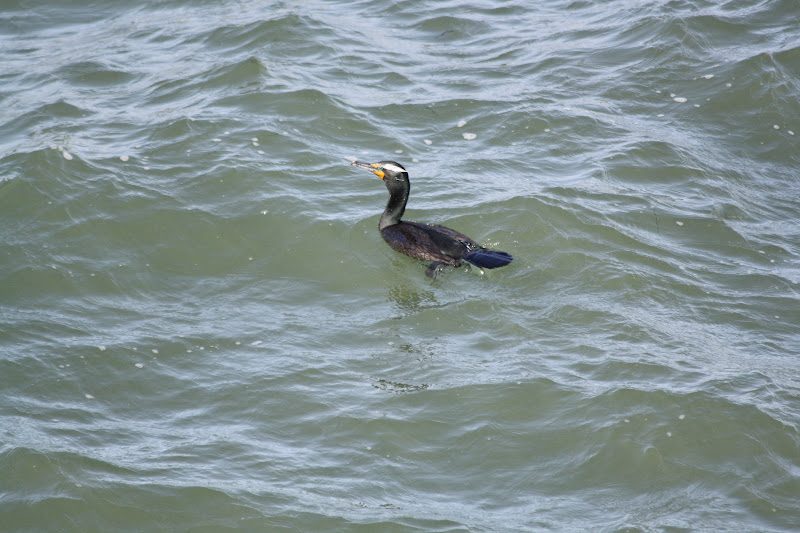
What I did notice were the regular Double-crested Cormorants. Difference being there were in full breeding plumage, something I had never seen before. The white feather-crests on each side of the head (which gave them the name) and the green iridescence can only be seen for a short period of each year. The average cormorants looked quite a bit more interesting with this bit of sprucing up.
Both Western and Heermann's Gulls were pretty abundant here, and the wind kept them suspended in the air long enough for some good shots.
 |
| A young Heermann's. |
I was a bit paranoid that even if there was a Clark's I would overlook it. Birds were diving all the time, so it wouldn't have been that hard to miss an odd bird. However when I did actually find my first
Clark's it was stark obvious, at least to me.
Now we have the two together, can you work out the differences? There are two reliable features in the head.
If you thought that the Clark's on the right
A. had more white on its face (compare around the eye) and
B. had a brighter orange bill (pale yellow-green on Western) then you would have been right. Knowing this, they don't seem that bad, but it takes a very good look at a bird to check these features. Remember that as they typically appear far out to sea (an obstacle fortuitously removed by the pier) these close views are very rare without the aid of a great telescope.
Royal Terns were sporadic here, but I did manage to get far better images of them this time.
While checking the waters off the end of the pier (and only finding some Bottlenose dolphins) I had a bird that I previously dismissed as a Cormorant due to its flight (low over water, rapid wingbeats) but I soon found it had white underwings which was something none of the locals had. It had a dark spot at the end of the wing and it suddenly looked a lot like a juvenile Masked Booby, which would be quite a rarity over this way. Of course it could have simply been a Common or Pacific Loon, which is superficially similar, but the distance was too great to differentiate these two birds that are not even remotely alike.
 |
| Another Heermann's ruffled up by the wind. I never knew they were white under their throat. |
San Diego River
_______________________________________________________________________
After that detour it was time to look for the Reddish Egret on the River a few minutes up the coastline.
A large flock of shorebirds was the first thing to catch my eye. It was mostly Willets and Marbled Godwits but foraging inbetween were 3 Short-billed Dowitchers. They were much tinier than I expected. I thought they were Least Sandpipers (another bird I am missing) until they extracted their beaks from the mud, allowing observation of its true length. Contrary to their name the bills of this species are actually pretty long, as is the Long-billed Dowitcher's which is only a little bit longer (though typically indistinguishable in length from the Short-billed unless side-by-side).
 |
| All three are in here; small and long-billed. Can you find them all? |
On the sand banks up the river I started to have more birds. In this area I had 2 Long-billed Curlews as well as the typical Marbled Godwits. Checking the image now, I also see 4 Dunlins in the center of the image (including one breeding adult denoted by the black belly).
 |
| These Long-billed Curlews have an extraordinary long bill even for a Curlew. |
Some terns started to appear just a little further up the river. While mostly Royal there were some other hidden birds in there including 2 Common and 2 Forster's Terns.
While looking through the viewfinder I saw a dark egret like shape amongst the terns, and there was my Reddish Egret. To be honest I was beginning to think it wasn't here. But I was mistaken. It was infact a [Little Blue Heron] (thanks Liam!), another vagrant egret to the region.
Would still rather call it a Blueberry Egret.
To finish things off I found a black beetle on the sidewalk. And I was quite surprised; it was a Darkling Beetle. Not a Darkling as in Mealworms, but a true desert Darkling beetle like those you see on National Geographic. Not something I expected to see.
The actual Reddish Egret was nowhere to be seen. Perhaps if I knew that was a Little Blue Heron then I would have searched further up the river.


 I only really had one goal for this trip, and that was to see a Yellow-billed Magpie. Once a bird that numbered in the thousands, the population of this special corvid has dropped considerably. I hear they even used to be found in Agoura, but now the furthest south they lie is many hours north of here. Santa Cruz is part of their range, and they are apparently surprisingly common in the right place. I mistakenly assumed they were just as urban as the European and Black-billed Magpies, but I couldn't have been more wrong; they were quite picky and only inhabited the right kind of oak woodland. No wonder I couldn't find any in the town of Santa Cruz.