Other Pages

Showing posts with label butterflies. Show all posts

Tuesday, October 16, 2012

Joshua Tree National Park Day 2 Part 2


I came across this little ladybird on the way to the Cholla Cactus Garden. Someone else in the car had found it crawling on their leg. It is a little Psyllobora of some kind, a genus of very tiny little mildew ladybirds. They are seldom seen due to their size; image trying to find one in a very extensive field of bushes.

I suspect it is Psyllobora renifer but I cannot find any evidence of it occuring any further west than Arizona. It is a distinctive species however so perhaps this shows either a range extension in the species or an unknown population. It certainly has the tendency to go unnoticed.

The Cholla Cactus Garden is somewhat well-known in the tourist industry. It is a giant field of Teddy-bear Cholla which is not found anywhere else. This cactus, while it looks furry, is not very welcoming. When you touch the spines they detach (along with a piece of the cactus) and embed themselves into your skin with barbed hooks. Good luck getting them out.

California Patch, Queen, Sleepy Orange and Cloudless Sulphur butterflies were present here (all but Sleepy Orange I will show pictures of later). Most of my photos were of reptiles and insects. I saw one bird very vaguely at the start but I could not see what it was.


Sleepy Orange; best shot I have, they don't seem to like sitting.

Next stop was a location called Split Rock. It was a rocky (duh) location that had some pretty interesting hikes, many of which off path and involving climbing some ledges. Needless to say none of them led anywhere interesting so I stuck to the nature-y looking trails.

There were some very vocal White-throated Swifts over the canyon. I have never heard these birds calling before so it was quite an unusual experience to hear them.


The only other bird was a medium-sized long-tailed bird that flew into a bush just underneath me. I originally thought it was a Say's Phoebe but the features were wrong. It took a bit of time but I finally worked out it had to be a Townsend's Solitaire; certainly not something I would expect around here. Solitaires were a mountain bird, and the nearest mountains were quite far off. From some research it seems they are a regular bird here in winter each year but in very minute numbers. Seeing it in flight confirmed my suspicions.


Here are some other photos from the site:

 
Dusky Chipmunk of the southern subspecies Tamias obscurus davisi
California Patch (top of photo, I honestly never got a better picture).
Next up was the Barker Dam region of the desert.


There was indeed a dam here, but it was by no means a large scale dam like you may picture, and at this time of year there wasn't even any water, though it did manage to attract quite a few tourists. In the car park there was a White Chequered-skipper. Luckily here there was no issue of separating it from the identical Common Chequered-skipper (in areas where they coexist the only way of telling them is by microscopic dissection of genitalia, what a job that is...) as the Common does not stray this far south nor does it favour the desert.
Yay, I don't have to list it as Chequered-skipped sp. I can actually put the silly little thing to species.
Many of the flora here was unique to the desert. Usually I don't post photos of wildflowers on this blog but sometimes I make exceptions.
Turbinella Oak (ssp. turbinella), a special desert subspecies of the Coastal Live Oak (dumosa). I think it is its own species now.
Opuntia chlorotica, sometimes called the Pancake or Flapjack Pricky Pear.

Opuntia littoralis.
Echinocactus polycephalus
A peculiar Darkling beetle, probably Philolithus actuosus.


Since there was still time left we made another stop at Hidden Valley. It was like Split Rock but a little more unique.

Here there were even more White-throated Swifts. It was apparent that they were gathering around here to roost in the coming hour.


Everyone else split up to "boulder-hop" the cliffs and I ended up taking a walk with the Marine Biology teacher (who I learned took Ornithology in college and he actually knows a hell of a lot of content). A peculiar jay call in the trees over the hill sounded eerily like Pinyon Jay but it could not be confirmed. I found a Western Scrub-jay in the area, but I was sure it sounded like Pinyon. Near the end of the trail we found a Rock Wren perched on the cliffside. Rock Wrens are funny little birds. Take a typical House Wren (or Eurasian Wren) and make it crawl up cliffs (x Wallcreeper or Nuthatch) and you have a Rock Wren. 

Small and brown but an unmistakable bird.
See if you can find it. Hint: its small and brown.
I managed to get some extra birding time in when three of the students went missing. Not that birding was the most important thing. Nevertheless they eventually returned, apparently "stuck" but without the sense to use their emergency whistle. On the way out I saw this bat flying high around the cliffs and managed to astound many people since they could not work out how I differentiated it from a bird.

Monday, October 15, 2012

Joshua Tree National Park Day 2 part 1


Last night was fairly interesting (in terms of trying to sleep!). Laying on my back and seeing the entire night sky was a little disorientating. On the bright side there was nearly no light pollution so the milky way and most constellations were easily visible. I also saw at least 3 shooting stars (I had no idea they were so bright and large) while trying to fall asleep. If I had my tripod perhaps I would have attempted some night sky photography but I could not hold the camera still enough without it.
 
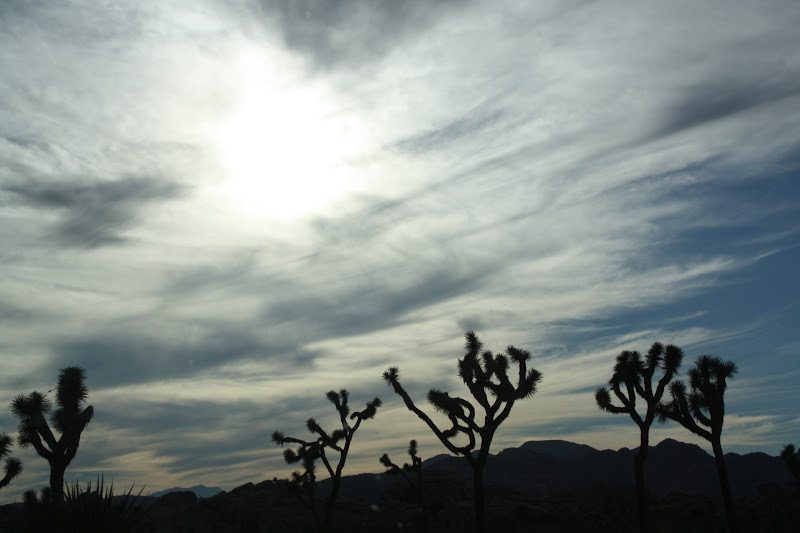
I was up at 6:30am, took a few landscape shots (as seen above) and checked the local wildlife. I was the only person awake.
 
The quails were up and about. Brewer's Blackbird was around too. There was some very extensive flocks flying high overhead.
 
Brewer's Blackbirds
 
Near the campsite I managed to locate a few Black-tailed Jackrabbits. They were very skittish but I did manage to get a couple of fairly decent pictures. I never saw them again.
 

I started hearing California Thrasher nearby. Their song is a jumbled load of mimicry and starling-like notes (compare Common Myna), much like a Mockingbird. It was a new bird for me so I pursued them and eventually got some shots of them. They were not especially tame but I eventually managed to approach them quite closely. Thrashers are usually very hard to find as they lurk deep in the bushes but early in the morning like this they perch on exposed branches and sing.

Other than the bill they aren't much to look at I guess.
Gambel's Quail females
The sun was out by 7am. More birds were to be found around this time. The Juncos and White-crowned Sparrows were around and singing. The best part was hearing and seeing Cactus Wren in the northern part of the campground. There seemed to be at least 2 resident birds here but they only appeared from 7-8am. At other times of the day they completely vanished. This concluded the morning.


The first stop of the day was the Twentynine Palms Visitor Center at Mara Oasis. It was close to development so it didn't appear very birdy but I was quite surprised. The light at the visitor center had attracted two moths the night before.

Geometrid moth--one of the so-called "pugs"

A noctuid or "Owlet" moth.
The Mara Oasis hike was a little trail that ran through the desert and around a vacant oasis. There is no longer any water visible, but the palm trees show that water did indeed exist at the location.

My first interesting find was this Western Pygmy-blue, the world's smallest butterfly. It didn't seem much smaller than an average blue butterfly at first glance but there was certainly a miniature feeling to it.


Phainopepla, that unique cardinal-waxwing lookalike, was quite numerous here. Apart from one female all the bird here were males. I am still attempting to obtain some good flight shots of this bird and I suppose you could say I partially suceeded.


Butterflies here included Chequered White and a Sleepy Orange. Otherwise there was not too much at the location as I had expected, however there was still a surprise left to see. There was a dark butterfly that flew low over the Honey Mesquite on the return trail -- a Great Purple Hairstreak.

Hairstreaks are notoriously hard to find due to elusive nature. This is one of the most conspicuous but by no means commonly seen.
It landed in the tree about 2 metres above ground -- so close I had to step back to get photos. And to think it stayed still when 21 people walked under it. This butterfly defies all qualities that hairstreaks typically show. Shame I couldn't get an upperside shot though when it took off. They are not as purple as the european Purple Hairstreak on the upperside but still pleasing to look at.

Ms. McCartney's father located this White-lined Hawk (Sphinx) Moth in the bush just outside the car. I really don't know how I managed to miss this. I tried to capture it so I could spread the wings for a full shot but it flew off instantly -- quite unusual for a hawk moth. They usually are very docile and sleepy in the day and it takes a lot to get them going.


Joshua Tree National Park Day 1

The infamous Joshua Trees.

Thanks to AP classes at Agoura High School I ended up somewhere quite far from home. I wasn't quite certain if I would see what I would expect. It was October now, so most summer birds were long gone. That meant no Scott's Oriole among other things but luckily most desert birds are resident all year so there was some hope there. There were only 21 people going (17 students + 4 teachers) and the price for all the hospitality and tours came to $160, which is quite a good sum for such a trip.

The direct cost for me was about 40 questions that had to be answered for a trip write-up afterwards. There was also a scavenger hunt which involved a list of animals and whoever found the most won. Yeah, I didn't really need to do anything special to have a (pretty high) chance of winning.

The drive was a little over 3 hours. On the way I thought I saw a Peregrine Falcon (think of a kestrel but much larger and greyer) but I could not confirm it. Looks like I'll still have to wait longer to tick this one.

Since we arrived at about 5pm and we had to set up tents and stuff there wasn't a lot happening today.

Campground view.

Desert Cottontail, though this the same one found around Los Angeles.
Cholla (pronounced Choy-a). Cholla are a type of cactus. I cannot find anywhere to identify the species.

A little walk all over the grounds found a Say's Phoebe, a few Oregon Juncos, House Finches and Bewick's Wren. At dusk, around about 6:30pm, Gambel's Quails started appearing around the back of our campsite. These quails were one of the birds on the main scavenger hunt but did anyone else care? Not really. It didn't seem apparent that anyone else really cared about this hunt.

It was getting quite dark so taking pictures wasn't easy, but I did get some good ones when the birds (surprisingly) stood still for a few moments. Because of the low light all it would take is for them to turn their head and I end up with a blurry picture. Only 3 or 4 of the 60 or so pictures I took were actually focused properly. Here is one of them:


 There were a few birds that flew into the Joshua Trees as it got dark but they made themselves impossible to locate despite the trees only being a few metres (or less) tall.

I spent most of the darkness messing around with the camera and partially fulfilling McCartney's optional objective of "obtaining pictures for the student yearbook". So that is what I did.


As the sun completely faded around about 8pm another interesting creature started showing itself; Kangaroo Rats. These little rodents are usually extremely skittish but they didn't seem bothered by people; infact at one point one of the teachers nearly managed to stroke one. It took me a few hours to get any decent pictures as they darted around all over the place but it was worth it.

Kangaroo Rat sp.


I have no idea what species you get here. I really wish there was some reference for Joshua Tree NP. I haven't been able to identify most reptiles, mammals and flowers I have seen here because there is nothing.