Other Pages

Showing posts with label año nuevo state reserve. Show all posts

Monday, April 16, 2012

Año Nuevo State Reserve (15th)

                                Año Nuevo Coastline
         
The reason for finding this reserve was because there were supposedly quite a few Elephant seals here, which was something that my mother was especially keen on seeing (though I think the sealions off the pier were enough to last her a few years).

This reserve was nearing Coastal Redwood territory, and would become a welcome change of scenery. Redwoods always remind me of Banana slugs, a peculiar slug that is bright yellow when young, but gains dark brown spots when it grows older in a pattern exactly like ripening bananas.

We made a stop at a rocky beach along the journey and it was certainly worth a look. In the surf just metres from the beach were (fittingly) a group of Surf Scoters. These remarkable ducks with extravagant bills really are something to see. It was not even comparable to the pin-prick sized flock I had previously seen, and even that is pushing it considering I could only just make them out by uploading the images on the PC and pushing the zoom as much as I could.


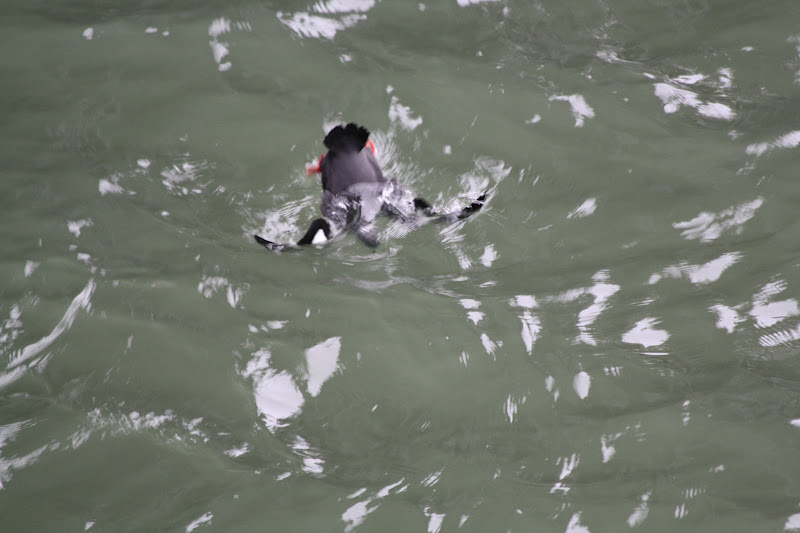
Due to the height and intensity of the waves about every other image looked like this.
You can't even see the other 3 female-type birds in this image.
 Also of interest was this long-awaited Caspian Tern. I assumed it was a Royal until I saw the images (I really need to check things more carefully...) where the scarlet-red and well-sized bill was more obvious. Caspians are amongst the largest of the terns, and naturally are one of the "Greater" terns. Many of the more well-known dainty species(genus Sterna for example) are typically less than half the size of these monster terns; if that isn't enough then all you have to do is compare the size of the bird to the Mallards behind it (and don't ask what these run-of-the-mill ducks are doing by a harsh rocky coastline with strong waves; they seem to get everywhere...).


Now that I had covered the interesting birds I had time to have a look at the area. The beach was mostly Whimbrel-dominated with a single Long-billed Curlew (not pictured, but I found it in one of my other images) which I wish I had known about at the time.

And surprise surprise another Mallard can be seen in this photo. Can you find it?


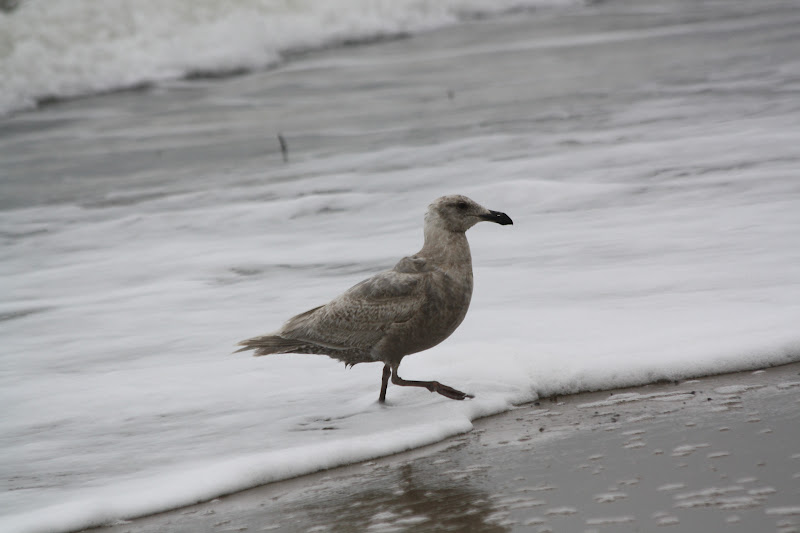
One of a few pale and probable Glaucous-winged Gulls.

                                Año Nuevo State Reserve
The atmosphere of the car park and visitor centre was comprised of a passerine song. The source, perched on the tip of a pine tree was a male Purple Finch. I have previously only seen two Purple Finches, but both were females.

 
About as purple as the red on a Reddish Egret. Was once eloquently put as "a sparrow dipped in raspberry juice" which is far more fitting.
  

A few swallows had appeared over the fields just by the car park. One happened to fly low and I saw a bright green; my nemesis and long-wanted hirundine; Violet-green Swallows. They only hung around for a matter of seconds, and it wasn't enough to get focused images, but the distinctive upper pattern was still visible in my images.

Someway down the path was a hole, and unlike the many other holes this one actually had something in it, despite my presence within a metre away. It was a...whatever it is. A pocket-gopher or something like that....Rodents are not one of  my areas simply because I have never found a resource.

Some pretty purple wildflower.
 On the way back I had some closer Swallows for better pictures, however these birds were brown on the back and had a brown smudge down the throat. My other nemesis hirundine; the Northern Rough-winged Swallow.
                                On the way back
American White Pelicans.

The Bicoloured subspecies of the Red-winged Blackbird is only found in northern California; it is not
something found in Los Angeles.

Santa Cruz and Año Nuevo State Reserve

Santa Cruz
_______________________________________________________________________
I was on the pier well before 7am, accompanied by a fair bit of fog, though luckily visibility was pretty much unhindered.


My first sighting were some dark birds in the waters further up the pier. Scoters I thought, but I could make out white wing patches; quite large ones. Black Guillemot was the first thought to cross my mind, but of course here it wouldn't be Black; it would be Pigeon. And that they were. Pigeon Guillemots are winter visitors, so I imagine I was quite lucky to catch them all in total breeding plumage (in winter they are dusky and grey). They were very delightful little birds. I was surprised to learn that the musical whistling filtering the air nearby was actually coming from these birds. Sea birds are not typically so well versed in lyrics.

I assume it was some form of courtship that these two birds were performing but it remains unknown.


Don't know about the Guillemots but the Gulls certainly had spring fever.

I also heard a loon calling somewhere off in the distance, which was undoubtedly a Red-throated. This is only the second time I have heard a loon's mystical cry, the first time being the vagrant Pacific Loon convoy I encountered in Alberta. But I still had yet to hear the stereotypical Loon's cry, which while similar is quite different from the other two.

Sure in a few minutes up popped a Red-throated Loon. I almost thought it was in breeding plumage which would be very spectacular, but it only had little traces of red on its neck. It was in mid moult, probably only days away from its full splendour.


Probable hybrid Clark's x Western. Bright orange bill yet a dull upper mandible and black feathers only just over the eye which is in the middle of the two extremities.

The pier seemed to be a favourite haunt of many California Sea Lions. I could hear them for a while, but at first I assumed it was speakers. The sound was actually coming from underneath the pier. 


Breeding plumage Brown Pelican.
And another Pigeon Guillemot was right next to the pier, though it dove before I could get any good shots.


This gull attracted my attention, yet the dark tips to the wings seem to point to an Olympic Gull.

I have no idea what gull this is:

Pigeon Guillemots again, this time tapping eachothers' bills.

What really caught my eye was this Clark's Grebe, this time even closer than before. The difference between the Western was so obvious I was able to I.D. it with the naked eye.

This bird was closer than any Western I've seen, and considering less than 5% of Westerns are Clark's I think that means I was pretty fortunate.
What was also fortunate was this breeding plumaged Pelagic Cormorant. My only previous sighting of this bird was only a speck in the distance.
 Now that I know breeding Pelagics look like the above, I really don't know what this bird below is. I figured the threads were a breeding plumage thing like the Double-crested, but that isn't the case. So what is this here?

To finish my time in Santa Cruz I finally decided to investigate some chickadee-like sounds in some trees nearby. I had been hearing it for a while but never had the time to check. The reason I was interested was because I was purely hearing "chickadee" calls and not any other calls, which alone rules out the chance of a sly Titmouse. There was only one chickadee around this area which I had not seen yet. Sure enough I had found some Chestnut-backed Chickadees.

The pictures were not great but this one shows the namesake chestnut back.


There was a male Myrtle Warbler in the area too, which I was led to by its distinctive chipping calls, which are similar but noticeably different to that of the Audubon's.

I will cover Año Nuevo State Reserve in the next post.