Other Pages

Showing posts with label paramount ranch. Show all posts

Sunday, October 7, 2012

Only two stars in the summer sky.

Yes, my summer hasn't been especially vivid even though there is so much left to see in California. And one of those 2 is a very scarce bird around here.

Both of these were from Paramount Ranch, one of my best locations in terms of productivity (and its only a 10 minute drive from me!).

The first is Vaux's Swift, California's second common swift. I have seen White-throated about 3 or 4 times now so this was deserved. In terms of abundance I would that if you saw a swift there is a 50/50 chance of Vaux or White-throated. These birds below were in a flock of about 6 flying high up over the Medicine Woman trail. It takes a sharp eye to see these pin-pricks in the sky, but idealistically now I've seen them both I will never have to search for them again!


The second is a rather rare bird in the area but fairly common overall in Norther America. Most birders would be able to guess this bird from what I say next. It had a bold white eyering, a fairly delicate "necklace" of dark streaks on its breast and a long tail that was white underneath. I never got to see the chestnut scapulars/lesser coverts and overall the views I got were not great.  It's funny how that even though there are 20 dull brown sparrows, they are all uniquely marked and coloured. In California it is an occasional up in the high desert but in these parts it is a scarce fall migrant.

Here is all I got of the Vesper Sparrow before it disappeared:

Now I've got those two out of the way here are some other local photos.

San Bernadino Blue, very similar to Acmon Blue.


My best shot so far of a Northern Flicker ssp. cafer. It was a flyover but it is far better than what I have already. The orange-red feathers are very clear in this picture as are the strangely-shaped tail feathers.

Tuesday, June 19, 2012

Indigo Bunting still at Paramount Ranch

The Indigo is still here. It's been around for quite a while now and many others have now seen it too.

It isn't being very photogenic, however. These pictures are cropped quite a bit. I'm still determined to get some better pictures.


I was very happy to see Yellow Star-thistle in the fields here. I have previously not seen it, and its been one of my most wanted flowers. I mean, a yellow thistle, what could be better than that?


I also found this butterfly, which I thought was a hairstreak simply by it being grey and the fact it was flying around the trees. It had a tail, too, which seemed to support this, though I think it may be a Tailed Copper. Not really sure.

Friday, May 11, 2012

Paramount Ranch~ INDIGO BUNTING

This trip to Paramount Ranch started earlier than normal; at 9am. Indeed today was a friday, and I was clearly sick *cough cough*, so hopefully there would be something to be seen here.

The main purpose of coming here was for my parents, at least my mother. She has started to get into nature, and now carries binoculars and a sketchbook. Flowers are her main thing.

And indeed unlike the visit here only a week or two ago this place was overflowing with wildflowers. House Wrens were strangely common and their song, the same song that lies in the background of many American TV programmes, filled the air throughout nearly the entire trip. A Yellow Warbler was heard singing in the trees above the creek just by the car park.  I saw it perched on an open branch; it is a regular sound in the creek and riverine habitats, but actually seeing them is another story. There were 3 Band-tailed Pigeons flying overheard, not that unusual but only the third or fourth time I have seen this species.

In the eucalyptus at the back of the village I heard a familiar call, that of a Black-headed Grosbeak. I almost thought it was a Downy Woodpecker, but the bill on this bird showed otherwise. It was a female. We started off along the Coyote Trail, and instantly I found this interesting Assassin Bug, Apiomerus californicus.


A. californicus is a relatively newly described species, originally considered conspecific with
A. crassipes. It was only offically  recognized in 2011; just last year. It is a predator
of bees, syphrid flies and wasps.
 Another Grosbeak promptly appeared; another female. The male could be heard singing nearby, but it didn't yield any views.


Don't normally get as good views as this; most birds hang out in the shady canopy of trees.
There are very few trees here, only bushes.
A pair of Turkey Vultures soaring overhead were joined by an almost invisible pin-prick in the sky, which later after going through my images turned out to be a White-throated Swift. It was only just identifiable To give an idea, here is one of those images. I'm surprised I even managed to see it with the naked eye. The picture below is zoomed in quite a bit, too.


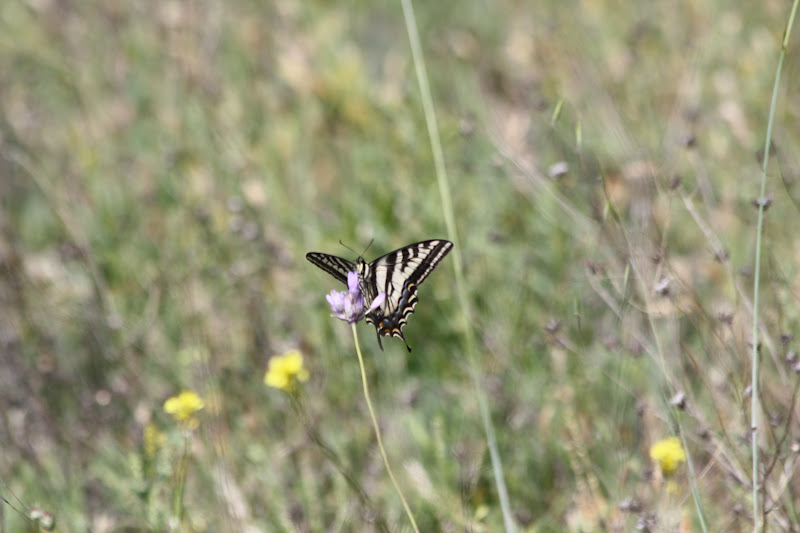
Several looks at wildflowers later, we came to a little field. A swallowtail was cruising around this area; a very pale one at that. It flew closer and I saw that the stripes were pretty bold. I instantly lost interest in whatever I happened to be taking pictures of at the time (which was a flowering Yucca) and was taking pictures hoping that one of the shots in flight would be focused. But it didn't matter, because the next best thing happened: it actually landed:


While not that rare, the Pale Tiger Swallowtail is very hard to come by and is scarcely seen that
frequently.

There was a pair of Grosbeaks this time, including one male. While somewhat fleeting, at least I got a look at the male before they left. I was more interested in some brownish nondescript birds in the bushes, however. I thought they were Empidonax at first, being dullish, having white wing bars and a white eye-ring, but a few seconds later I recognized them as Hutton's Vireo. And here I was thinking they looked similar to Ruby-crowned Kinglets. I take that statement back now, because they are nothing like them.
Two lizards were up the path ahead. The first doesn't seem to be a Western Fence, but I don't know what it is without consulting a guide.
The second is a surprisingly large Tiger Whiptail:


The sound of cicadas was quite consistent during the walk thus far. It wasn't the obstreporous metal grinding or the incessant droning, instead being a single click repeated every few seconds, something pretty regular with the small inconspicuous Tibicen cicadas. Of course it was near impossible to a get a good look at them in such dense shrubbery, but while walking I heard one exceptionally close to the path. And sure enough I actually saw this impossible insect. It even sat still for several minutes.

*Note, Tibicen is referring to Tibiceninae as in the family, not the genus Tibicen.

Tibicen cicadas are very numerous and diverse, though at the same time are pretty much
impossible to tell apart, so I have no hope in even putting this to genus level.

A Tibicen family Cicada is a lot smaller than it's noisier Cicadine cousins.
A further walk up the path and I ended up retracing my steps at the call of a Wrentit. The "ping-pong ball" song of this bird is common, but they are one of the hardest birds to physically see. This particular bird was in a low tree just over the path, and I did manage to get some good, though brief, glimpses of it.
While not a good image, with Wrentits you can't hope for anything.
It shows the face, though, which in my personal bird photography terms makes
this a success.
Another male Grosbeak appeared and sung vibrantly in the path ahead, and a few more flower stops later I caught sight of an unknown orange-black Checkerspot butterfly just as it was flushed by my mother in te yellow flowers on the side of the path. Checkspots are quite uncommon, and it was quite unfortunate as I never saw it again and remain with no photos of it, making it the first species I have ever actually "missed" in any country. A second Tiger Whiptail was seen near the intersection with the Medicine Woman trail, and it also meant the 10 minutes Coyote trail took us 1 hour to traverse due to constant stops.

Along the Medicine Woman trail was another orange-and-black butterfly, though too big for a Checkerspot. It was a Fritillary of some sort, I assume Callipe by looks but I am not familiar with the local species. Luckily it co-operated and I got a picture of the underside, which in Fritillary terms is the only sure-fire way to identify most species. It was one of the "Brown-underside" Fritillaries, a self-proclaimed group which the Callipe is a member of.


 There was not much else to note for a while. After the boardwalk at the apex of the Medicine Woman trail things started to appear again. This male American Kestrel was the first thing seen, and yet another House Wren was singing. Bullock's Orioles started appearing; I had two, at least one was a male. This was the spot I saw a single male a few weeks ago.

At the lone oak tree at the top of the semi-hill, yet another Bullock's male flew out of the tree. What I was more interested in was a flash of blue in a large oak tree on the opposite side of the path. It instantly went into the canopy and I did not get a good look, but it eventually flew out and I saw it was completely blue on the back, so it obviously was not a Lazzy. I thought maybe it was a Blue Grosbeak.

As it was about to perch it was chased off by another identical bird, also bright blue, which meant there was at least two. They continued to fight eachother for a while, and it was getting kind of frustrating; I just wanted to see them sit still. Eventually one of them did:


It wasn't just blue; it was completely blue. And its beak was thin. There was only one thing that could be, but it would be quite rare for this side of the United States. It wasn't a Lazzy Bunting or a Blue Grosbeak, but an Indigo Bunting. And there were two of them. A couple of similarly-behaving brown birds at the back may have been females, meaning a tenative four birds. The only thing better than a rare bird is lots of them.

After the view pictured, it disappeared completely, though it did make a final passby before disappearing into the oaks. The birds were completely mute, and even when I played the songs and calls on my Ipod there was no response. Since they had disappeared, there was not much else to do but continue the walk, though nothing could mellow the excitement of seeing a rare bird in full breeding plumage; most Indigo Bunting sightings are of dull brown juveniles.

The remainder of the walk was spent teaching my mother how to tell the difference between Cabbage Whites and Chequered Whites in flight, and surprisingly she managed to pick it up very quickly.

There was an immature Say's Phoebe in the village area. It perched on the wooden fence and flew under the eves of the houses.
And soon I found myself back at the carpark, having undertaken a very productive walk. It was an example of how wildlife fluctuates greatly in the early hours of the morning. My 1pm walks have never been like this.

Monday, September 5, 2011

Paramount Ranch, 28th August 2011

Having been requested to plan a weekend by my parents, and have them say "Oh, let's go to x place" as soon as we get into the car, I was not very optimistic about visiting this location, especially as it was effectively as much a tourist destination as Disneyland, which you may know is not remotely nature based.
Paramount Ranch was a filming venue for a number of films and TV shows (even today in 2011), functioning as the stereotypical "Old West Town".

It was supposedly very close to where I was staying, and when we crossed the bridge over the highway and took a very little road up into the hills, we understood this fact (it didn't even take 5 minutes to get there) very clearly. The habitat was not so much the chaparral that I am used to visiting, but more of what is known as "Oak Savannah" which is virtually dry plains with oak trees and the odd shrub. Despite this relatively new habitat (just as dry and hot as chaparral canyon habitats) I did not expect to find anything different here.

Driving past the entrance into the car park I saw what seemed to be ravens perched on the post, but they were bald around the neck, and sitting so still I had to check they were actually real. There were three birds in total, all missing neck feathers, and all with their beaks open a bit (this is something I've noticed a lot in birds around here; assuming its heat that causes this behaviour).

In the car park I saw a Chequered White (a male) and a few California Ground Squirrels.

The entrance was a bridge over a little river, bordered on all sides by riparian tree species. I heard a Yellow Warbler in here but could not locate it. There was nothing on the river here, but I was certain Night Herons made a pass by here. Across the bridge perched on the fence was yet another partly bald Raven.


As we entered the "ranch" itself I heard a familiar call in the only oak tree in the town itself; an Acorn Woodpecker. This specific woodpecker is apparently common in this area but I have never seen or heard one in real life before (I had remembered the call from a recording on a site). After a very thorough search I eventually managed to find it sitting very quietly on a branch. Note that its beak is open not because its calling (I never actually saw it call) but because I am assuming its hot like the Ravens.


At the back of the town were two seperate patches of white-barked Eucalyptus trees. I could have sworn they were imported from Australia, but it seems they are a natural occurence here. A White-breasted Nuthatch was foraging up the tree halfway, then coming down again (Nuthatches are some of the only birds that forage downwards, except for Sittellas and a few other foreign birds I am not aware of no doubt). Trying to get good shots was frustrating, as when I followed it just hopped around the other side of the tree no matter what direction I walked in (this sort of thing is definately meant for a cartoon). I spent about seven minutes chasing it but in the end I gave up, not that I needed a picture anyway. A last look around here found a female Yellow Warbler and a Black Phoebe.


At this point I started hearing a bird call that I have been noticing rather frequently, but never been able to identify. I managed to locate the bird's position in a (especially) dense oak tree, and saw it fly out, but again I could not get a look at it. The call was much like the Least Flycatchers (often described as "que-bec", but it more sounds like "ch-pi") I heard, but never saw (one of the "easiest to see birds", too), in Alberta. The only flycatcher in these parts is the Pacific-slope, but I was not sure from my far off flight shots if this even was a flycatcher. It flew very high for one thing.

The same bird returned a few times, each time in a very high oak tree with way too many leaves. A single wing was the most I saw. If it wasn't for a single House Finch standing in the same area it was , maybe I would have seen it better.

Between then and leaving, I saw a flock of Rock Doves casually fly over the horizon. I had not yet got a picture of this species so I made sure to take a record shot just for the, well, record. Strangely, these birds had peculiar patterning. The primaries and most if not all of the secondares were black, and the remainder pale grey; not a colouration typical, if ever present in Rock Doves. All of the birds in the flock shared this patterning. My suspicions of a certain pigeon species were confirmed when I compared the wing pattern in the photos to that of the Band-tailed Pigeon which it matched perfectly. I was glad to finally pick up this bird.

List courtesy Eremaea.com

Period: 8/28/2011
List: 91124
List Status: Published in Atlas
Observer: James Bailey
Notes: Also seen: California Ground Squirrel and male Chequered White.
Species: 12

SpeciesScientific NameCountComment
Anna's HummingbirdCalypte anna1 
Acorn WoodpeckerMelanerpes formicivorus2In large oak tree in center of 'town'.
Nuttall's WoodpeckerPicoides nuttallii1 
Black PhoebeSayornis nigricans  
Western Scrub-JayAphelocoma californica  
American CrowCorvus brachyrhynchos  
Common RavenCorvus corax  
Oak TitmouseBaeolophus inornatus  
White-breasted NuthatchSitta carolinensis1In the white eucalyptus on the northern side (close to the undercover area with many tables where the banjo concert is held).
Yellow WarblerDendroica petechia2Male & female both seen.
House FinchCarpodacus mexicanus  


Band-tailed PigeonPatagioenas fasciata6Single flock over car park. Assumed Rock Dove at first, but colouration on top of wings was wrong.

Band-tailed PigeonPatagioenas fasciata6Single flock over car park. Assumed Rock Dove at first, but colouration on top of wings was wrong.