Other Pages

Showing posts with label wood-warblers. Show all posts

Thursday, January 29, 2015

Chinsegut

Before I take this blog post to its intended destination I will start off by adding a section about Chinsegut Wildlife Center. We found out about this center literally by opening up a map and pointing at it. There was the fear that it was one of those children's education places rather than a real park with content to admire, but it was a good decision. It turned out to be one of the best but overlooked birding areas in the county.

One of the common inhabitants is the red-headed woodpecker, a bird which is quite rare elsewhere in this part of Florida. Other than their appearance at feeders, they are usually invisible and shy, so this at-feeder photograph is the best I have at the moment:


This wooded location also boasts all other Florida woodpeckers except red-cockaded, including the sizeable pileated woodpecker. Pileated is an elusive and skittish species whose laughing call carries far and wide, penetrating an often silent wilderness. Often a single bird is echoed by other in the immediate vicinity, but they are generally uncommon and spread out over large portions of woodland. Naturally it is generally heard far more often than it is seen, the best chances of seeing these birds is hearing one and having the luck to be beside it. Since the presumed loss of the ivory-billed woodpecker, the pileated has now become the largest living species of woodpecker on the continent. And big they are! Far larger than any other American woodpecker, they are quite striking birds if you get a good look at them.


The giant woodpecker comes to light: exceptional views of this secretive shade-loving woodpecker.
In other notes, a bird I've yet to get good photos of is the "yellow" palm warbler. Palm warblers are probably the most abundant bird in Florida during winter, but most of them are the brown "western" subspecies and they turn up everywhere. The yellow palm warbler or "eastern" palm warbler is less common. Whenever I include a yellow palm warbler in my bird sightings ebird gives me the flashing green "RARE Are you sure?" notification. They certainly aren't that rare though, I tend to see at least one in any well-sized palm warbler flock. In some cases nearly half a flock can be yellows. Unfortunately they are very quick to leave the scene and certainly don't stay around long. Too bad.

A passable photo of a "yellow" palm warbler at Chinsegut. Some birds are nearly this yellow, but they are most likely hybrids between the two subspecies. Perhaps next time I'll manage to change my camera settings before it takes off.
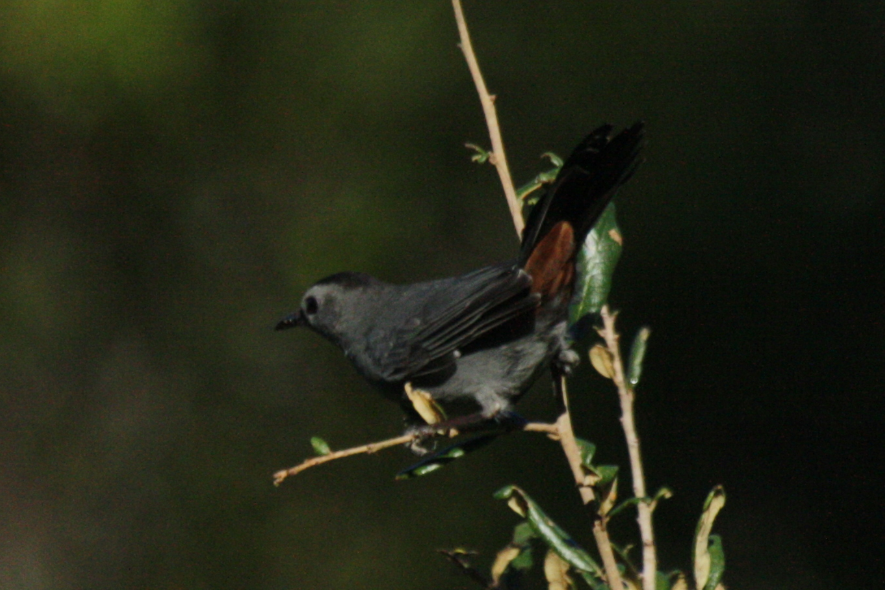
Another winter visitor to Florida is the grey catbird. This skulky bird is named for its raucous call that does not exactly pass as a cat, but I guess I can see where they were coming from. I mention this bird as on this particular visit I had my first actual views of this species when I flushed one while walking past a bush. I was half expecting my first views to be part of a tail or such but in the apparent consternation of being spotted this one seemed to forget that it was meant to be a secretive and invisible bird:


I'd also like to offer a mention to the white-eyed vireo. This species is rarely common anywhere, but in Florida we are lucky enough to have this bird resident all year round. I had my first encounter with the species while getting to grips with its songs and calls on my iPhone during a quiet section of the forest. During one of these playbacks I heard wings in a bush beside me. I raised an eye to this new shadow and there it was! I purposefully had the sound on low to avoid disturbance, but it seems I underestimated avian hearing. The bird had come from well across the forest to seek the mystery intruder.

The pale eye is unique to this particular vireo, at least in America. 

"Now where did that sound come from?"
"Must be here somewhere."
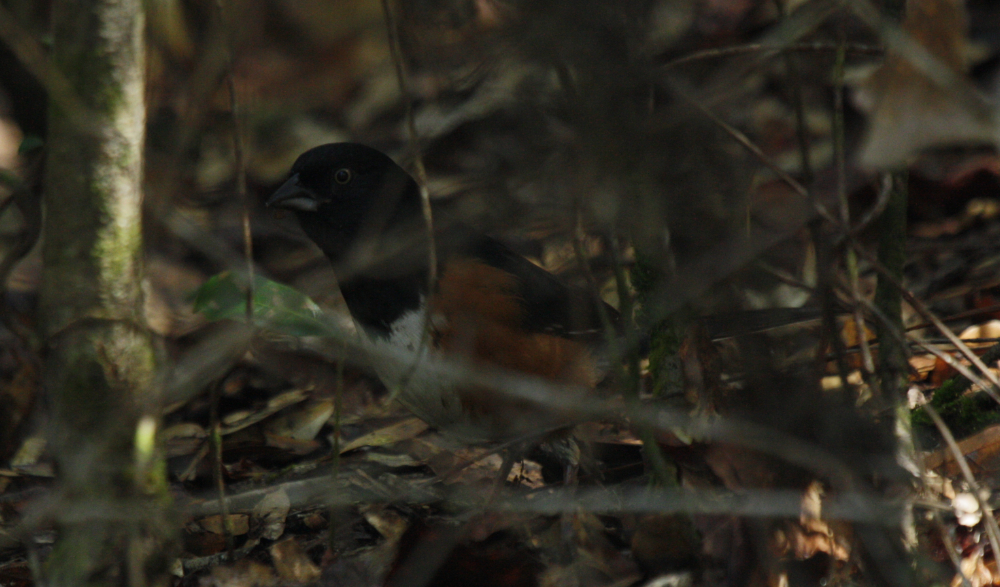
Keeping up with the skulky and pale-eyed theme is the eastern towhee. A cousin to the abundant spotted towhee in California, the unspotted eastern towhee shares the same leaf-kicking behaviour. They don't seem to be as diverse in vocals as spotted towhee, instead they tend to monotonously use the same calls over and over, but an otherwise "nostalgic" bird.

Eastern towhees lurk in shady areas and hedgerows, kicking up leaf litter as they go. They are not usually that flighty, but generally not tame either.

Eastern towhee sneaking around.
This species was once called the rufous-sided towhee when it was merged with the spotted towhee.
Finishing up the skulking theme is the thrush-like warbler named for a nest that it builds on the forest floor. This odd warbler hardly looks like a warbler and is certainly quite different to other members of the family. Unlike the towhee this bird bolts at the slightest sound and often hides in deep cover which makes it rather frustrating to get a good look at. This all assumes you even see the bird dart away to begin with, you are far more likely to walk past it. I now present: the ovenbird.


The final highlight of the day was this stunning yellow-throated warbler that hopped around the windows of the visitor center.


Thursday, January 22, 2015

Hernando County Bounty

Since visiting Florida it has been a bit overwhelming with all the new species. For everything I see in the west there is often an eastern equivalent, which means despite the fact I'm still in the same country I'm almost starting from scratch!

To start this post off I'm going to show off a colourful garden bird common in eastern North America. This bird is superficially similar to all other typical members of its kind and certainly doesn't win awards for taking risks with its plumage choice. Though it may share the same red-black-white colouration of virtually all north hemispherean members of its family, it is still unique. Here is the red-bellied woodpecker:


This rather fantastic looking bird is quite common in the right places here in Florida, and possibly also one of the loudest and raucous woodpeckers I've encountered. Though perhaps this is because it is quite a sociable woodpecker who is often accompanied by several others of its kind. Unlike other woodpeckers, it knows how to show off that stylish red hair. Unfortunately those who named it were so jealous of this amazing hairstyle that they named it after something far less conspicuous; the slight pinkish tint on the underparts of many (but not all) individuals:


Another topic worth mentioning is the crazy amount of ospreys in Florida.  I remember my first osprey in Wales, it was a tiny (but fantastic) dot through the world's longest telescope at a "secret" location. My views of this spectacular bird of prey were changed a little in California when I had seen one flying over the horizon on a particularly good day. Here though, they are just everywhere. I think I've seen more ospreys here than I've seen feral pigeons and starlings combined.

How you see an osprey in Florida. Distance to osprey: less than 10 meters.
How you see an osprey in the UK (through the word's best telescope). Distance to osprey: over 5 miles.
A unique coastal species that is apparently quite common here is the black skimmer with its very peculiar beak. I had distant views of this species in California once, but only once. They are more confiding here, and seemingly more abundant too.


I could not end this post without some insect life, starting with some locally common butterflies.

Long-tailed Skipper
Zebra. A trademark member of tropical butterfly houses, flying here as if it were nothing.
Both sides of gulf fritillary. One of the most vividly coloured butterflies here for sure.
A monarch fighting a queen over flowers in Fort de Soto Park. Interesting that the monarch actually seems to be "kicking" the opponent, not a behaviour I was aware of in butterflies.  I'm sure a good joke could be made here, but I can't think of it.
Fort de Soto Park was probably worth a blog post in itself but I will try and pick out the highlights here. One thing Florida is quite good for is herons and egrets. I think every regular species in North America occurs here, which is a significant 13. Florida is certainly a good place to be for a heron, as there is water everywhere and no lack of fish and aquatic prey.

On one particularly memorable occasion at Fort de Soto Park I was quite literally surrounded by herons. I first watched this little blue heron lurking in mangrove shadows:

Ridiculously tame.
A little to the right was a white ibis alongside a fantastic tricolo(u)red heron:

Behind me was this white-phase reddish egret:

On the coastline down the beach was a little egret. And in the trees far away was a great egret. What a place. Earlier in the trip I spotted an unmistakably bright pink spot on the horizon. Even though it was a few miles away it was undoubtedly a roseate spoonbill. I hope to see one closer eventually.


An extra incentive for Fort de Soto Park was the reported groove-billed ani, one of the most peculiar of cuckoos that occasionally wanders up into the United States, usually in Texas. Unfortunately there was not a lot of information on its whereabouts, with people just saying it was "south of the North Beach car park". I met a few other birders who were equally puzzled on the directions, so after an hour I so I just walked around and hoped it would find me. While surrounded by herons I had heard its squeaky-toy whistle and glimpsed it very briefly on top of a shrub down the path. Nice! I made a bit of a dash to the path on the other side of this hedge and after a good few minutes of waiting turn around and see it just sitting there. For such a supposedly skulky bird it was rather tame.

Note the grooves on the bill as per its name.
A good head on-shot because not many people take (or keep) head-on shots.
 I also managed this comparison image with a lark sparrow too. I didn't realize it at the time but lark sparrow is actually a considerably rarity here as well. I see them all the time in California so I didn't give it a second look!

Credit given to the lark sparrow for finding a new way to make shades of brown look interesting.
I had the time to go find other birders, most of which had given up, and put them on the ani as well. They were well chuffed. Looking back, technically the spot was south(west) of the north car park, but it was hardly useful information on its own...ah well.

And I...don't know where to put this so...have a moth.
A nice moth: Hemeroplanis scopulepes

All in all, you could say it has been a good first week in Florida! I haven't covered even half of what I have seen in this state so far, but perhaps during longer reprises from trips I'll stick some "themed" posts together in the future.

Tuesday, August 5, 2014

Corn Creek revisited

On the annual Las Vegas trip, faced again with an hour time frame in which to visit the local wildlife, I opted again to check out the Corn Creek field station, both a migrant trap and a regular site for a few local specialties. I did not post my last visit, but Corn Creek quickly became one of my favourite birding spots. I like to think of Corn Creek as a bit of a "wildcard", since it is totally random what is seen (and what isn't seen!) on a visit to this location on any given time of the day at any given time. Last visit I found Nevada's 9th NBRC endorsed record of purple martin which was quite something.

It was good to see that the heavy construction setup had vanished, along with the rather obnoxious clamour it threw up if you were standing in the immediate vicinity. In its place was the new (but closed) visitor center, a car park, and toilets, which was exactly 300% more facilities than the last time I visited. There was a fair bit of weather nearby, rain and thunder/lightning, which fortunately had diminished prior.

I first visited the "orchard" area. I don't actually remember this area so I think I missed it last time. There was quite a tremendous amount of activity here, mostly western tanagers but also orioles (hooded, Bullock's) and a lone (but attractive) male indigo bunting. The fence was occupied throughout by about one black phoebe every 10 metres, vigilantly keeping to their invisible territories. I also played an Abert's towhee recording to remind myself of their vocalizations, and was sure I heard a reply far off but I could not be sure. Other than this I did not encounter such a bird during the trip.

For the next few minutes or so I checked up on calls to make sure I knew what I was hearing--Nevada, though it is not too far from California, has a wealth of new possibilities. I was perhaps a bit out of my element here, so I didn't discount a new bird hiding behind a familiar sound. For instance, I had heard a sort of metallic "chik" call; what I assumed was a bunting, probably indigo or lazuli, from within a dense patch of undergrowth nearby a little creek. Wait, dense undergrowth? Buntings live in the open, perched on exposed branches, or even hopping along open grasslands, so this instantly raised a red flag. I took one step and a dark bird dashed out and landed on a branch a couple of trees down the creek. I could see a white supercilium line and pale underparts from where I was standing, the rest shrouded by leaf cover. I thought perhaps it was a black-and-white warbler, a bird that would have those sort of features, but a little repositioning on my part revealed some interesting streaking and a face that looked like it came from a thrush.

It was now very obvious that I had a waterthrush on my hands. The waterthrushes were odd thrush-patterned warblers known for their love of water--a bird that could not be named in any better fashion. Only two waterthrush species exist: the northern waterthrush and the Louisiana waterthrush. So here is what I was thinking right at the time, to give an idea of the situation for a non-birder:
Erm, hang on a minute...Neither of these maps are even close to where I am.
Often in birding the common conundrum is deciding between a regular species and a rare species. Rarely is it that the conundrum is deciding between a rare species and a rarer one! I tested the calls of both species, and it sounded thinner than northern waterthrush.

The bird then, as its habits would dictate, flew into the water of the creek and hopped along the stones perfectly at home. Exposed in the open, the bird really stood out in its high-contrast dark-brown back and clean white underparts. Another feature that stood out here was its rather bright pink legs. Typical of waterthrushes, it flicked its tail regularly at increments of about 7 seconds+. Along with its unmarked white throat and lack of buffy colouring overall, it was quite clear I was dealing with a Louisiana waterthrush, by far the rarer of the two this far west. Update August 5th: this bird was refound by others today and confirmed as the 3rd-4th NBRC record, what a great bird to find.

A bit lost would be a bit of an understatement I'd say, though Nevada
does seem to be a bit under birded, so perhaps it is more common than it is thought.

In other parts of the park I located a Virginia's warbler foraging silently in some low trees. This is a mountain species at this time of year so here in the low desert it is another good bird but not necessarily rare. I did not have any luck with Lucy's warbler at the site. I picked up 2 black-throated sparrows on my way out of the park and along with 2 loggerhead shrikes on the drive out, this concluded the visit. I definitely do not regret coming here.

Virginia's warbler. The diagnostic yellow undertail is only just visible through a gap in the leaves.

Black-throated sparrow

Saturday, October 12, 2013

Laguna voyages

In the recent past I have managed to convince my parents to take me on two separate visits to the Laguna Rd. tamarisks. For those who don't know, this road, set in the middle of the rural farmland, is home to a line of trees known as tamarisks. For some reason, they create a migrant trap for birders (and for farming they create a windbreak to stop soil erosion). Also, blogger seems to decompress photos now so they won't look as high quality as they should be. Not sure what changed but you'll probably not notice anyway.

A migrant trap is best described as follows: You are walking in the middle of a desert, thirsty and starving. Suddenly you see a bench with a cup of water and a pizza. Clearly you'll instantly gravitate towards this place. And that is how the migrant traps work; birds from all over congregate in these traps, and thus it is basically a way to see all birds within a many mile square area in a small place. Naturally, all the rarities within the many mile square area place will also come, so as you can imagine these migrant traps become rather lucrative. Its nice to spend 10 minutes checking all the local birds, rather than over 40 minutes as is the usual case. Of course, birds do like to hide, so you will always miss some.

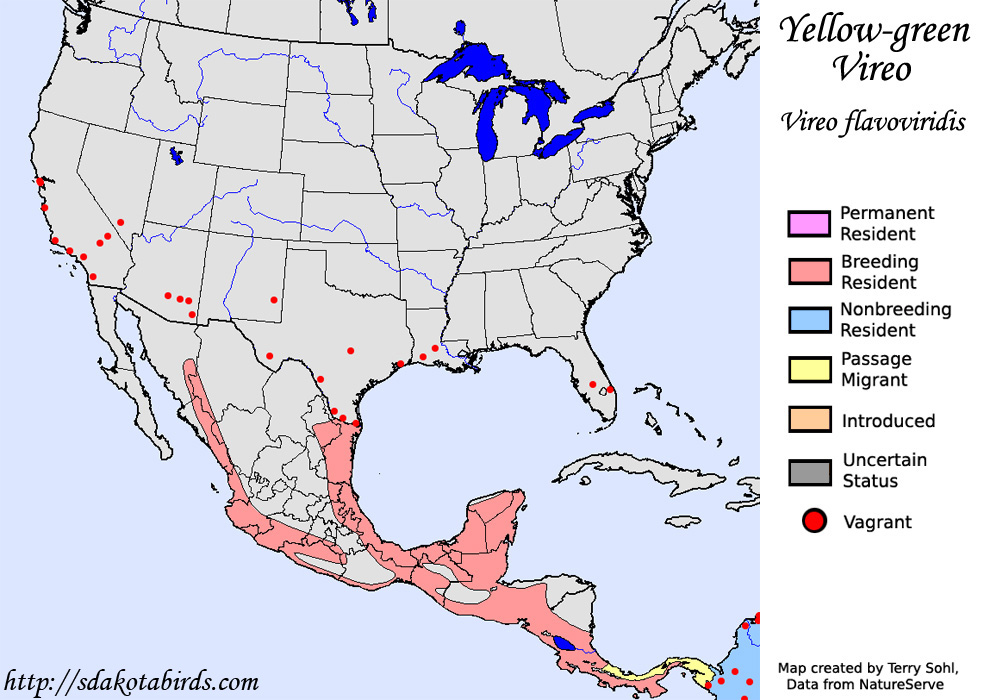
On September 28th was the first visit. The target was a vagrant yellow-green vireo and a vagrant American redstart which had been present in the days following up. Yellow-green vireos are a pretty big bird anywhere in North America, as shown by  this map. The pink shaded areas are all in Mexico, with a tiny region dripping over the right-hand side into North America. The red dots represent random vagrant sightings, such as the bird at Laguna.

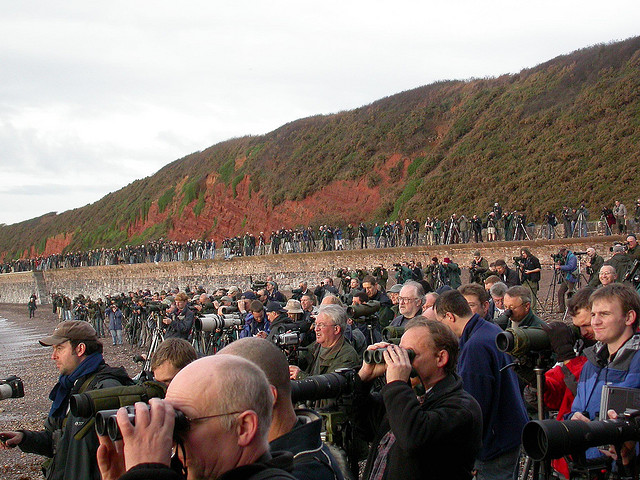
I'd say that this first visit was the first time I've really encountered a "twitching party". Twitching parties are groups of people standing in one place with binoculars and stupidly long lenses focused in one place. There were probably only 13 people here but that is still a fair amount. I guess you could say the migrant traps are people traps too since similarly people are drawn in to these places from all over. There are two behaviours of twitching parties, which is either that they are standing in one place with all the lenses focused in one place (good) or they are all wandering around like lost sheep (bad). Fortunately behaviour #1 was being exhibited, and naturally they had already found the bird and saved me about 10 minutes+ of searching and possibly not finding it.

Yellow-green vireo.
Unfortunately they were all so in awe of the bird that no one even bothered to look for the other vagrant bird which was the Redstart. I didn't find it when I searched the far end of the trees, and no one had seen it that day (however it was found on the next day, so it must have been somewhere). Something else happened today, and its a rare thing to see. So there were two "twitching parties" here. One, which I was in, had the bird and yelled to the other group to get them over here. However, the second group yelled back, also saying they had the bird, which confused everyone. Behaviour #3.

The source of the confusion? There were actually two yellow-green vireos! The chances of even one appearing is pretty low so it was rather comical when people were running back and forth and switching "teams" constantly. I also picked up on a yellow-faced warbler which was my long-awaited hermit warbler, an uncommon migrant though regular through the state, which instantly disappeared and could not be refound. Its unusual how birds can just turn invisible in a single tree.

Fortunately I did refind it, and others confirmed my identification. However they weren't even looking at my bird, and it then occurred to me that there was another hermit warbler about 3 metres from my head just beside me, and sat in the open rather puzzled.

Hermit warbler in basic plumage.
Otherwise, the tree row was full of Townsend's warblers, along with a few black-throated grey, orange-crowned and yellow warblers. I understand some readers won't know what a Townsend's warbler is so I will post an image. They are fairly common and definitely under-rated.


The second visit was today. With the yellow-green vireos and redstart long gone (along with a few other nice vagrants which I missed out on being sat at home) there were some new birds to seek. I had to choose between going to Marina del Rey for blue-footed booby and Laguna for Prothonotary warbler. I couldn't resist the Prothon. There was a bit of a second motivation, with a nearby park holding recent sightings of a magnolia warbler, one of my all-time wanted birds.

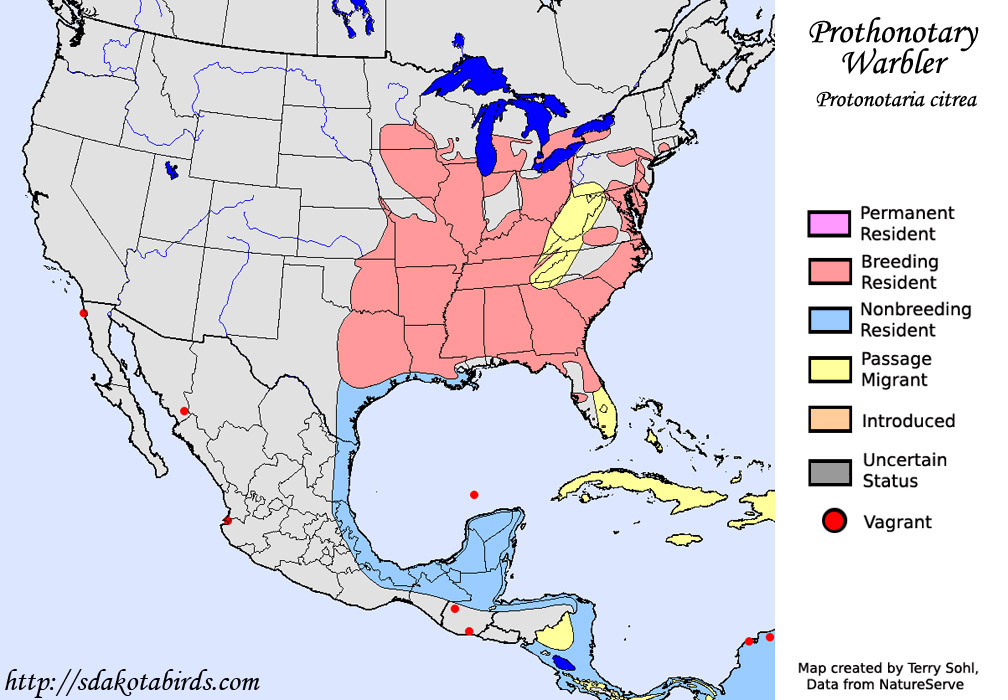
Prothonotary warblers, as their latin name citrea may suggest, are rather yellow. They have a slightly different beauty that the yellow warblers that are common around here. Prothons are vagrants, as shown by this map. The map is actually rather old and doesn't even show any records for California, though there have been many. For those outside North America, California is that diagonal south-east facing region just above the red dot on the left-hand side. Its a fairly uncommon bird to see even in its natural range so there was not really a fear of wasting my time. In this sense I mean something like the following situation: let's say I dedicated all this time to finding a rare bird, but at some time in the future I end up in a country where the beaches are covered in them. Though there is something special about seeing a bird in a place where it is unusual, there is always a feeling of trying to prioritize species that you probably won't see at all in your future life.

So like last time, there was a twitching party, slightly smaller. They had the bird about 5 minutes before I arrived (generally the last thing anyone wants to hear) but were sure it was still present. You could tell how bored they were by their incessant pursuit of a Macgillivray's warbler, a generally regular migrant to the area. The tree row was flooding with birds this time, I'm not sure what it was that increased their numbers so much since last time. Townsend's was the majority, with well over 20 individuals, about 11 Wilson's warblers, followed by about 4 black-throated greys. Pacific-slope flycatcher was rather abundant also.

Macgillivray's warbler

Wilson's warbler; mostly included this image just to show the colour of them.

It took about 25 minutes to refind the prothonotary warbler; it was in the same place, and right above the party the whole time yet it still managed to hide itself all that time. It was rather tricky to find the bird among the just-as-yellow Wilson's. In the middle of this sighting was a surreptitious Tennessee warbler which I only barely saw behind all the cover. Only a few others actually saw the bird so it was a good sighting. Tennessee warblers are another vagrant from the east.

Prothonotary warbler.


Tennessee warbler; you may be wondering how anyone can identify a bird as obscured as this,
but there are really only two birds that this could be. The white eye-ring and overall dull yellow colour are fairly unique. Orange-crowned is the other species, a common species in California, but that white area just visible under the tail instantly rules that out, leaving the vagrant Tennessee. Kudos to whoever managed to ID this bird when
it was hopping around though.


I could have stayed longer for better opportunities on the above two birds, though I wanted to check the other park nearby. Someone told me that the magnolia was seen this morning so that made me feel positive about it, though since it was nearing midday it was possible that it had moved off. With the car parked along the Eston street side of Pleasant Valley Park, I started walking along the tamarisk row. It took 10 seconds from leaving the car to see a flash of yellow between the lower branches, and that was the bird. A record time for finding a rare bird! 3 rare birds within an hour isn't bad at all.

My dodgy photos don't do it justice.


Wednesday, October 10, 2012

Nuthatch Memories, and PALM WARBLER x2

The Red-breasted Nuthatch is a high altitude bird, occasionally moving into lower altitudes during winter. This year has been more exceptional than usual, with quite a lot of records. Something about the recent conditions must have encouraged them. It was certainly something being on my daily commute and hearing that unfamiliar yrrnk yrrnk call from the pines, where I've previously had White-breasted Nuthatches, the common species here.


I could not be sure if there was just one, or two birds present, with the scarce looks. However, on another note, later in the day I noted a small brown bird along the dirt slopes nearby. A normal brown bird, probably a sparrow...until the tail flicking begun. At this point, the brown bird is no longer normal.

Tail-flicking is not hugely common in birds, and it's feature can be a good means of quick recognition in some cases. It recalled a situation in Alberta where I came across a similar tail-flicking brown migrant bird, which turned out to be a transient Palm Warbler. While pondering that thought, I had a Nashville warbler pop up in the willows nearby.


Said tail-wagging bird was clearly not too pleased at being overshadowed, so it flew towards me and hopped into a tumbleweed.


And then it hit me, very clearly. Wait, it is a palm warbler! And not one, but two showed up, side-by-side. Although this was uncommon in Alberta, palm warbler is a vagrant in California. In other words, the difference between possibly expected, and not expected at all!


What a find! Interestingly palm warbler is not often seen in palm trees; this name was applied to the finder of the species who indeed collected the first specimen from a palm tree. John Acorn thought the name "bog warbler" would be more fitting, matching the swamps and marshes that the species calls home normally. Hah, an idea for later!