Santa Monica
_______________________________________________________________________
Total: 1
I'd certainly been looking forward to Marina del Rey, because it had two birds, the Surfbird and Black Turnstone, which I had yet to see.
But Marina del Rey was not the first on the list. My parents wished to scour the shopping lanes at Santa Monica (and it was my mothers' birthday so I couldn't really complain). I almost thought I had a Great-tailed Grackle (a common local bird) at one point but unfortunately it was just another Brewer's Blackbird.
Santa Monica still had some tendency to provide new birds, because it was on the coastline and had an extensive coastline. I still had those two uncommon winter gulls (Glaucous-winged and Thayer's) to find. While uncommon they seem to pop up in reports all the time, so they can't be that hard to find (says me who can't even find the common birds in my area. Stupid thrashers and grackles don't exist.).
But gullwatching is unique. At first it seems easier than "normal" birdwatching, because all the birds are either stealing food or flying overhead, and both in great numbers. I probably see more than 100 gulls in one beach trip. After a while you learn what balances this type of birdwatching out. Typically, birds have 3 plumages at any one time of the year; juvenile, immature and adult (not including genders). But not gulls. They have 4 basic plumages named by the year they are in; 1cy, 2cy, 3cy and 4cy. Cy stands for calendar year, and does not relate to the bird's age as such. If a gull gains its 1cy plumage in October 2010, it does not keep it until October 2011. As soon as the new year turns over it is considered a 2cy bird (you can be more in depth and call them first summer, winter etc. but then it gets complicated).
Not only do they look different each year, but there is also intermediate (half-moulted) birds and simple species variation. Now this can be tolerated in most places, but in California there is something worse; hybrids. So now you have the 1234cy plumages of two gulls mixed together, and due to the way of genes each bird comes out slightly differently. And what if this hybrid is half-moulted? The number of gulls (while good for species lists) makes it harder with the Western, California, Ring-billed, American Herring, Mew, Glaucous-winged and Thayer's complex.
Naturally I forgot to check the underwing plumages of gulls, but at least if there was a Glaucous-winged here it would be easy to identify because they are one of the palest gulls around. The other local gulls are very dark grey on the mantle, but the glaucous winged is pale grey. They also lack the stereotypical black primaries found in nearly all other gulls. If I had a 4cy bird there would be no mistaking it.
So while being alert for pale gulls I made my way down the pier and back. Western and Heerman's were everywhere, as per usual and there were a surprising amount of Ring-billed Gulls (these birds are winter visitors) and I hoped that if there were a lot of Ring-billed finding there way here then the other winter gulls would too.
My first pale gull of the day was halfway down the pier, but since my camera was off (I don't know why it was off) I missed the good shots. However the pictures were good enough to tell it was an Olympic Gull, the best feature being the black tips to the wings (which a pure Glauc never has). Yes, a fancy name but this is just a Glaucous-winged x Western hybrid and untickable as it cannot be assigned to species! The fancy name is the only thing cool about it after you've seen your first one....
Amongst the gulls offshore was a single Pacific Loon.
The second pale gull was back on land. It took little observation to see that this nearly all-white gull had no trace of dark plumage. The bird circled around a particular tree for a while before abruptly disappearing. I had no idea how it could have got away behind this tree without notice because the tree itself wasn't a very big one. From sheer luck I managed to get the images focused on the gull and not the tree behind, and there was my 4cy Glaucous-winged Gull.
The underwing pattern resembled a faded Western, but the black spot on the bill ruled out a leucistic Western or other hybrid, so the I.D. was as definite as it gets.
Don't get me wrong, just because I was looking for one does not mean I expected to find one! There was a pretty good chance based on the amount of gulls here (I would have rated it at more or less around 15-30%) but I still didn't expect it.
Marina Del Rey
_______________________________________________________________________
Total: 0
So finally, after all this time I had the chance to check out the marina. As already mentioned, I was keen on finding both the Surfbird and Black Turnstone. Both were apparently effortlessly seen here in the winter (The Surfbird has been found on 100% of reports by visiting birders) and what is better than definite new birds? Even better there was a report of a wintering Long-tailed Duck here (a vagrant to the region, but hard to find even in its natural habitat) which had been sticking around for a week.
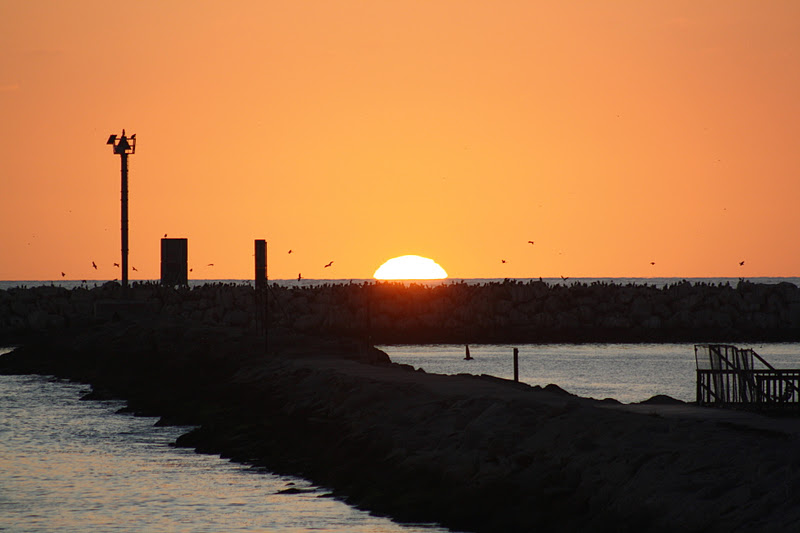
Of course it is never that simple and it took some time to actually find the "right" spot (most of it was private access, boats only etc.) and in the end I had to survive with Playa del Rey, which is on the other side of the river. And because of shopping I couldn't get here until 4pm, where the sun had almost completely set, and there was very little time to locate things before it became totally dark.
Ballona Creek was a nice area. Immediately upon arriving I found a very obliging Red-throated Loon on the water within metres of the car (and it made no attempt to swim away when I approached). It was a lot better compared to the distant views of that fleeting bird a few weeks ago.
In the rocks along the creek were some Willets, two Whimbrels and what seemed to be a Marbled Godwit. A flock of Bufflehead were further up the river along with three female Red-breasted Mergansers.
 |
My first blurred flight shot for a while....I find it interesting that the wing
markings are identical to the Hooded Merganser though. |
This rather large flock of Willet also flew past, and had too many birds to fit into one photo.

Other than some Sanderling flying north up the creek I could not make out anything else, not even Surfbirds. But I did appreciate some close encounters with grebes. A pair of Western Grebes were probably the most appreciated (let me remind you on the speck-sized sightings previously far out to sea) and there was also a pair of Horned Grebes here. On top of this there were three grebe-like birds that huddled together at all times (even when diving) but for some crazy reason I didn't even check what they were! (Though I think they were also Horned Grebes; but this social behaviour seems odd).
Western Grebes
Horned Grebe
 |
This picture is interesting because the reflection
parallels its breeding plumage (black with gold ear tuft)! |
And still no Surfbirds. I have managed to make a dent in the 100% reporting rate even though they are supposed to be always present. I must have been looking in the wrong place?
 |
Cormorants fill the rocks here, but somehow I didn't notice
them until I posted the image on this blog! Perhaps that is where
the Surfbirds were. |


 Next was another Willet, or so I thought. I passed it off as it had black and white wing markings (which I considered all varations of to be stereotypical to the Willet) but then I remembered that the Surfbird sported similar markings. The stubby bill seemed to match, but then I had a recollection of the Pluvialis plovers (i.e. Pacific Gold) having this wing pattern. In the end it turned out that it was a Pluvialis; a Black-bellied Plover. I was really hoping for one of the other two birds.